A Puppy in a Cage No Longer: Why Change Can Feel Scary Even When Freedom Is Waiting
For anyone who feels trapped by fear, this story offers a gentle reminder: Sometimes the door is open before we feel free enough to walk through it.
This Sparkle Story was written by a coaching client who had struggled with anxiety for many years. Through the image of a puppy in a cage, she found a gentle way to express fear, hope, safety, and the slow return of freedom. The story reminds us that healing is not always about forcing ourselves to be brave. Sometimes healing begins when we realize the door may already be open.
A Story About Fear, Freedom and Recovering Your Sparkle
When coaching clients, I often ask them to write their story.
Not because everyone must become a writer. Not because grammar is the doorway to healing. Heaven help us if that were true; many brilliant souls would be stopped at the comma.
I ask because stories have a way of opening doors that ordinary explanations leave closed.
Sometimes, when a person writes, something hidden becomes visible. A fear takes shape. A longing finds language. A younger part of the self peeks out from behind the curtain and says, “There I am.”
And sometimes, both the client and I are surprised by the insight, creativity, courage, and growth that happen through this work.
The following story was written, part by part, by a coaching client. She had suffered from anxiety and panic attacks for many years. Through story, she found a way to find herself again and to express feelings that were difficult to name directly.
The puppy became a gentle mirror:
afraid, hopeful, cautious, alive, and slowly learning that freedom was possible.
Writing this story helped her gain insight, begin to loosen the grip of fear, and take steps toward living her sparkle — her best life — just like the puppy in the story.
Here is the story she wrote, slightly edited for clarity and flow:
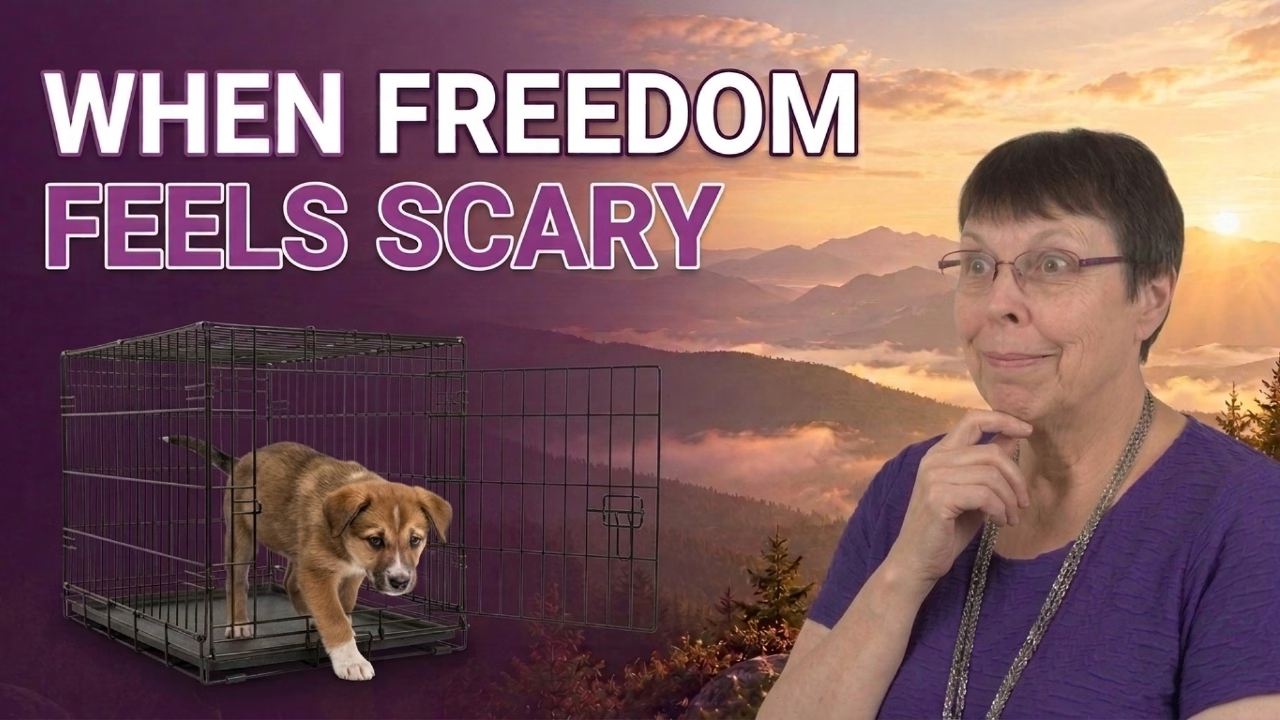
Shared with permission of the client. Identifying details may have been changed to protected the client's privacy.
By Dr. Christine Sauer — physician & educator | Educational content only
Listen to the Story...
If you prefer to listen, here is my narrated version of this Sparkle Story.
or go directly to reading the story...
A Puppy in a Cage No Longer
There was once a puppy in a cage.
He was not an old dog, tired of the world.
He was young at heart, made for grass and sunlight, for muddy paws and ridiculous joy.
He was the sort of puppy who would chase a butterfly as if it were a royal mission, sniff a worm with serious scientific interest, and greet every human as a possible friend.
A puppy is born believing in friendship.
But this puppy lived in a cage.
People passed by, and still he lifted his head.
Still he wagged his tail.
Still he hoped.
Each time footsteps came near, something inside him rose like morning.
Perhaps this time.
Perhaps now.
Perhaps the door would open.
But often the footsteps passed.
The door stayed closed.
And little by little, the puppy’s heart broke in quiet pieces.
Still, one small piece remained. And in that piece lived hope. Not a grand hope. Not a loud hope. Just a small, stubborn spark that said:
One day, maybe, I will be free.
The puppy had food. He had water.
He was not forgotten in the ordinary ways.
His bowl was filled. His needs were met...
At least, the needs that could be seen from outside the cage.
But there are needs a bowl cannot answer.
A puppy needs to run.
A puppy needs to play.
A puppy needs to belong.
A puppy needs someone to open the door and say, “Come. You were not made only to wait.”
Years passed.
The puppy grew, and the cage did not.
One day, while he was turning in circles, trying to make himself comfortable in a space that had become too small, something happened.
The door opened.
The puppy stared.
Nothing moved.
No one called. No hand reached in.
No voice said yes or no.
The open door simply stood there.
The puppy wanted to run. Every part of him wanted it.
Yet his paws stayed still.
He listened for footsteps. He looked for the people who owned the house.
Had they forgotten to close it?
Was it a mistake?
Was he allowed?
The room beyond the cage seemed enormous.
Freedom, when one has only dreamed of it, can be frightening when it finally arrives.
For a long while, the puppy did nothing.
Then something inside him gathered itself.
He stepped out.
The floor felt strange beneath his paws. The house was wide and unfamiliar. Shadows seemed larger than they should.
The puppy moved carefully, then stopped.
What if he was caught?
What if someone was angry?
What if the cage, small as it was, had been safer after all?
Then another door opened.
This one led outside.
Light came through it.
Air came through it.
A smell he did not know came through it — the smell of grass and earth and distance.
The puppy froze again.
Behind him was the cage.
It was small, but it was known. There had always been food. There had always been water.
He had never had to search for anything.
He had never slept beneath the sky.
He had never been hungry.
At least, he thought he liked the food.
He had never tasted anything else.
Two men came through the open doorway, carrying something heavy.
The puppy hid. The door began to close.
And then he ran.
He ran as if his legs had been waiting all their lives to remember what they were for.
He slipped through just before the door shut behind him.
He did not look back...
Outside, the world was larger than his dreams.
He ran and ran.
He leapt into the air. He rolled in the grass.
He tasted it and found it strange, but wonderful because it was his own choice.
He chased a butterfly and nearly caught nothing at all, which seemed good enough.
He saw a worm and considered eating it, then decided some adventures are best left for braver stomachs.
For a little while, the puppy was only joy.
Then evening came.
The light faded.
The air grew cold.
The open world, so beautiful in the sun, became strange in the dark.
The puppy did not know where he was.
He did not know where to sleep.
No bowl appeared.
No familiar sounds told him what came next.
He thought of the cage.
He thought of the food.
He thought of the door that had closed behind him.
Had he made a mistake?
The puppy found a place beneath some branches.
He curled himself as small as he could.
He shivered.
He was free, but he was alone.
And freedom, without love, can feel very cold at night.
At last, he slept.
For the first time in a long while, he dreamed.
He dreamed of a home where he was not kept merely alive, but loved.
A home where someone opened the door not by accident, but with welcome.
A home where he was taken for walks, called by name, petted with kindness, and invited to play.
Morning came.
The puppy woke hungry.
There was no bowl.
No cage.
No familiar hand.
Only the sound of the world beginning again.
He heard footsteps.
He held still.
A small person appeared — not much taller than the puppy himself.
A little boy.
The boy saw him, bent down, and lifted him into his arms.
The puppy did not understand.
Was this danger?
Rescue?
Trouble?
He did not know.
Fear had taught him to question even kindness.
The boy carried him to a house that was not the old house.
Then he ran inside and returned with food and water.
The puppy ate.
He was so hungry that, for a moment, fear stepped aside.
The boy brought him inside.
A grown-up looked at the puppy and nodded.
The puppy’s heart trembled.
Surely they knew where he belonged.
Surely they would take him back to the cage.
He watched the boy closely.
Should he wag his tail?
Should he stay very still?
Should he hide?
He did not yet know the rules of this new place.
Then the boy brought out a ball.
A ball.
Something ancient and joyful woke in the puppy.
His tail moved before he gave it permission.
Then it wagged harder.
The boy laughed and rolled the ball across the floor.
The puppy ran after it.
He did not know how to catch it properly.
He bumped it with his nose, chased it under a chair, lost it, found it again, and acted as though this were the greatest work ever given to a creature under heaven.
And perhaps it was...
The boy took him outside.
The puppy ran in the grass again, but this time he was not alone.
Someone called him back with kindness.
Someone fed him.
Someone laughed when he missed the ball.
Someone was pleased simply because he was there.
And slowly, the puppy understood.
He had not escaped one cage merely to be lost in the world.
He had found a home.
A place where he was not only fed, but loved.
Not only sheltered, but welcomed.
Not only kept, but known.
The puppy had been afraid of the open door.
But beyond the door was grass.
Beyond the grass was night.
Beyond the night was a child with a bowl.
And beyond fear was a life he had almost forgotten he was made to live.
The puppy was in a cage no longer.
What This Story Teaches Us About Healing
This story is simple.
That is why it works.
It does not explain anxiety with medical terms.
It does not lecture about trauma, avoidance, nervous system safety, or learned fear.
It simply shows us a puppy standing at an open door.
And many people understand.
Sometimes the cage is no longer locked.
But fear still believes it is.
Because change can feel scary, even if it leads to something beautiful.
Sometimes life has changed, but the body has not caught up yet.
Sometimes a person is safer than they used to be, but their nervous system still expects danger.
This is one reason change can feel so confusing.
From the outside, someone might say:
“Why don’t you just leave?”
“Why don’t you just try?”
“Why don’t you just move on?”
But from inside the cage, the open door does not always look like freedom.
Sometimes it looks like danger.
The familiar cage may be too small.
It may be lonely.
It may even be painful.
But it is known.
The unknown world may contain grass, sunshine, play, friendship, and joy.
But it also contains darkness, hunger, uncertainty, and risk.
That is why healing often happens slowly.
Not because a person is weak.
Because fear has been trained.
And what has been trained usually needs to be gently retrained.
Safety Before Courage
One of the most important parts of this story is that the puppy does not become free simply because the door opens.
The open door matters.
But it is not enough.
The puppy also needs safety.
Food.
Kindness.
A little boy.
A ball.
A place where he is not only tolerated, but welcomed.
That is very human.
Many people cannot recover their sparkle through willpower alone.
They need experiences that teach the body:
“I am safe enough now.”
They need small moments of trust.
They need people who do not force the door open and drag them out.
They need someone who can sit nearby, offer kindness, and make life outside the cage feel possible.
Sometimes healing begins with a question.
Sometimes with a story.
Sometimes with a person who says, in one way or another:
“Come. You were not made only to wait.”
A Reflection on this Story...
This story is about more than a puppy.
It is about fear.
It is about safety.
It is about the strange way human beings can outgrow a cage and still feel afraid to leave it.
If you would like to explore the deeper meaning behind the story, watch this reflection.
Recovering Your Sparkle
Recovering your sparkle does not always begin with confidence.
Overcoming anxiety sometimes begins with one small step.
One paw outside the cage.
One honest conversation.
One safe relationship starts to build resilience.
One moment of laughter.
One tiny experience of joy.
The puppy did not become brave all at once.
He peeked.
He froze.
He ran.
He got scared.
He felt lonely.
He needed help.
And then, slowly, he remembered how to play.
That is often how people recover too.
Not in a straight line.
Not by pretending everything is fine.
But by discovering, one moment at a time, that life may still hold grass, sunlight, friendship, laughter, and belonging.
The cage may have been real.
The fear may have been real.
But the door may be open now.
And sometimes that realization is the first sparkle.
Reflection Questions
As you read this story, you may want to gently ask yourself:
You do not have to answer quickly.
Sometimes the best questions need time.
A Gentle Invitation
If this story touched something in you, I invite you to stay curious.
Not judgmental.
Curious.
Maybe the question is not: “What is wrong with me?”
Maybe the question is:
“What happened to make the cage feel safer than the open door?”
And maybe another question is waiting behind that one:
“What would help me feel safe enough to take one small step?”
That is part of the work of being human.
And it is part of recovering your sparkle.
This article is educational and reflective in nature. It does not provide medical care, diagnosis, or treatment.
If you are struggling with anxiety, depression, trauma, panic, severe distress, or thoughts of harming yourself, please seek appropriate professional support or emergency help in your area.
You are not weak for needing help. Sometimes another human being helps us see the open door.
Want a clearer, less overwhelming and More Enjoyable way to think about brain and mental health?
Join the DRC email list for stories that you can enjoy and think through, educational insights, frameworks, and evidence‑informed perspectives — no hype, no quick fixes.
Subscribers receive complimentary access to all essays in The Five Dimensions of Human Health series, including stories and reflections that don’t appear on the public blog, as well as early drafts as the books take shape.
This is not a newsletter in the usual sense.
It’s a place to think carefully, over time, about what health, suffering, and healing actually ask of us.
Join the Essays and receive them directly by email, as they’re written.
One thoughtful email most Tuesdays. Unsubscribe anytime.
About the Author
Dr. Christine Sauer
Physician • Educator • Author
Dr. Christine Sauer is a German‑trained medical doctor (MD) and natural health doctor with over 40 years of experience in healthcare. She writes educational content on brain health, mental health foundations, stress physiology, and whole‑person healing, drawing on clinical experience, medical science, and integrative health principles.
Her work focuses on helping readers understand what’s really going on beneath symptoms—without hype, fear, or oversimplification. Dr. Sauer is the author of multiple international bestselling books and a TEDx speaker, known for translating complex health topics into calm, practical, evidence‑informed guidance.
This content is for educational purposes only and does not replace personalized medical care.
Frequently Asked Questions About [seo keyword]
Change can feel scary because the nervous system often prefers what is familiar, even when the familiar is uncomfortable. A new situation may be healthier, safer, or more hopeful, but the body may still react with fear until it has enough experience to trust the new reality.
The cage can represent anxiety, old survival patterns, fear, shame, learned helplessness, trauma, depression, or any situation that once felt necessary but now feels too small.
The open door represents possibility. It may be a new relationship, a new choice, a new chapter, a safer environment, a healing opportunity, or the realization that life may be larger than fear has allowed you to believe.
Recovering your sparkle means reconnecting with the aliveness, hope, meaning, courage, joy, and inner light that may have been buried by stress, fear, loss, illness, trauma, or years of survival mode.
Because freedom alone is not always enough. Many people need safety, belonging, reassurance, and companionship before they can fully step into a new life. Healing is not only about leaving what harmed us. It is also about finding what helps us live again.
Last Updated on September 19, 2026 by Dr. Christine Sauer