
Not Every Experiment Needs Replication
What Marshmallows Can Teach Us About Self-Compassion after Mistakes
Once upon a time, on the Mountain of Life, there lived a marmot named Sparkly.
Sparkly was a thoughtful marmot. Mostly.
He had a purple scarf, a little backpack, kind eyes, and a tail that glowed softly when hope was nearby. He also had a curious mind. This was often useful.
Sometimes, however, his curiosity became more committed than his wisdom.
That is how the marshmallow experiment began.

Sparkly had reason to suspect that marshmallows did not agree with him. This was not the first time the question had come before the council of his stomach.
Still, the bag looked inviting.
So he approached the matter scientifically.
He ate one marshmallow. It was sweet.
He ate another to confirm the finding.
He ate a third because conclusions should not be rushed.
After that, inquiry became less disciplined.
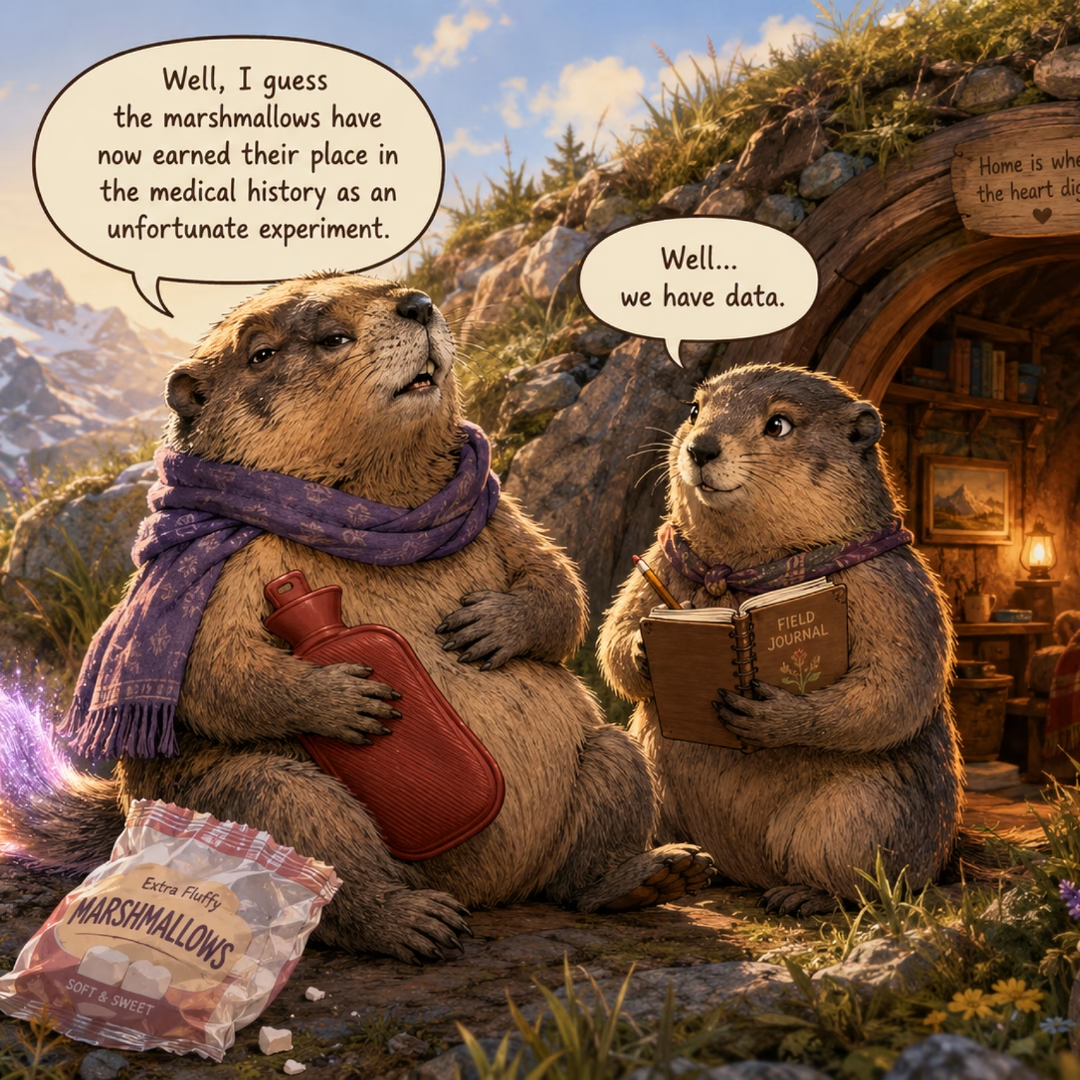
Later, Sparkly sat outside the cozy mountain den, holding a red hot water bottle against his belly. The empty marshmallow bag lay nearby, quiet and incriminating.
Alma, his wife and steady mountain partner, sat beside him with her small field journal.
Sparkly sighed.
“Well, I guess the marshmallows have now earned their place in my medical history as an unfortunate experiment.”
Alma made a note in her journal.
“Well,” she said gently, “we have data.”
Sparkly looked at the empty bag.
Then he looked at Alma.
Then he looked at the hot water bottle.
This was not the look of a marmot ready for replication.
Alma closed her journal and said, “Not every experiment needs replication.”
And that was the beginning of wisdom.
The Marshmallow Experiment is a gentle Sparkly story about self-compassion after a choice that did not work well.
Self-compassion does not mean pretending the choice was wise. It means saying, “That did not work well,” without adding, “Therefore, I am hopeless, weak, stupid, or incapable of change.”
A mistake can become data. A pattern can become information. And information can help us choose the next true step.
Not every experiment needs replication.
Now we know.
When We Already Suspect the Answer
Most of us have our own marshmallow experiments.
Not always with marshmallows.
Sometimes we eat something our body has already questioned.
Sometimes we stay up too late even though we know the next morning will be difficult.
Sometimes we say yes when we are already overloaded.
Sometimes we enter the same old argument, hoping this time it will somehow end in peace, clarity, and perhaps a small parade.
Sometimes we ignore our need for rest.
Sometimes we keep pushing because we think stopping would mean weakness.
Sometimes we return to an old habit because a small voice says, “Maybe this time will be different.”
And sometimes it is different.
But sometimes it is not.
Sometimes the mountain simply says, “You have seen this trail before.”
That does not make us foolish. It makes us human.
There is often a gap between what we know in our minds and what we are ready to accept in our behavior.
We may know something intellectually before we know it emotionally.
We may understand the pattern before we are ready to stop repeating it.
We may need one more direct and memorable experience before the lesson becomes real.
This is not ideal.
But it is also not the end of the story.
Self-Compassion Is Not Pretending the Choice Was Wise
Self-compassion does not mean pretending the marshmallow experiment was brilliant.
It does not mean saying, “This was a wonderful decision and I have no notes.”
Sometimes the honest sentence is:
“That did not work well.”
That is enough.
The trouble begins when we add a second sentence:
“Therefore, I am hopeless.”
Or:
“Therefore, I am weak.”
Or:
“Therefore, I never learn.”
Or:
“Therefore, something is wrong with me.”
That second sentence is usually where shame sneaks in and pulls up a chair.
Sparkly could have built a whole courtroom outside the den.
He could have put the empty marshmallow bag on trial.
He could have called his belly as a witness.
He could have declared himself a failed marmot, unfit for snack-related decision-making.
But he did not need a court.
He needed a lesson.
He did not build a court where a lesson would do.
That is self-compassion.
Not denial.
Not excuse-making.
Not pretending consequences are imaginary.
Just the quiet refusal to turn one poor choice into a verdict about your whole character.
A Mistake Can Become Data
Alma’s response was small, but wise.
“Well… we have data.”
That sentence changes the whole meaning of the moment.
Data is not shame.
Data is information.
Data says:
This happened.
This was the result.
This may be a pattern.
This is worth remembering.
This can guide the next step.
Shame says: "What is wrong with me?"
Data asks: "What did this teach me?"
Those are very different questions.
One closes the door.
The other opens a path.
The shame did not help much.
The noticing helped more.
That is true for many things on the Mountain of Life.
If staying up too late leaves you anxious and foggy the next day, that is data.
If saying yes when you are already exhausted leads to resentment, that is data.
If a certain argument always leaves you feeling small and shaken, that is data.
If your body keeps objecting to something you keep repeating, that is data.
And if symptoms are new, severe, persistent, or concerning, that is not simply “data for self-reflection.” That is a reason to seek proper medical evaluation.
But many everyday patterns can still teach us something.
The point is not to become afraid of every wrong step.
The point is to notice which paths keep leading to the same painful place.
The Mountain of Life Contains Experiments
The Mountain of Life is not a perfectly marked sidewalk.
It has weather.
It has wrong turns.
It has steep places, confusing signs, old habits, false shortcuts, and snacks that should probably remain one-time research projects.
We do not climb perfectly.
We learn.
Sometimes we learn by wisdom.
And sometimes we learn by direct and memorable experience.
That second way is less elegant, but it can be very effective.
A wrong turn can teach you where the trail is not.
A storm can teach you what gear you need.
A heavy backpack can teach you what you can no longer carry.
An unfortunate marshmallow experiment can teach you that a certain bag does not need to come home again.
On the Mountain of Life, the goal is not to avoid every mistake.
The goal is to notice where you are, understand what the terrain is teaching you, and choose the next true step.
Not ten steps.
Not a grand life overhaul.
Just the next true step.
After an Unfortunate Experiment
When you have repeated something that did not work well, try asking these questions gently.
Not like a judge.
Like Alma with her field journal.
1. What happened?
Describe it plainly.
No drama. No insult. No verdict.
- “I stayed up too late.”
- “I said yes when I was already tired.”
- “I ate the thing my body keeps objecting to.”
- “I entered the same argument again.”
- “I pushed past my limit.”
Just name it.
2. What did I notice?
What happened afterward?
- In your body?
- Your mood?
- Your energy?
- Your sleep?
- Your relationships?
- Your sense of peace?
This is where the data lives.
3. Is this a pattern?
Have you seen this result before?
Once may be an event.
Twice may be interesting.
Several times may be the mountain tapping politely on the map.
4. What does the data suggest?
Maybe the answer is continue.
Maybe it is adjust.
Maybe it is reduce.
Maybe it is stop.
Maybe it is rest.
Maybe it is ask for help.
Maybe it is choose another route.
The answer does not need to be dramatic to be useful.
5. What is my next true step?
Keep it small.
The next true step might be:
- “I will not buy that again this week.”
- “I will go to bed 30 minutes earlier tonight.”
- “I will pause before saying yes.”
- “I will step out of the argument before it becomes the same old trail.”
- “I will ask someone for help.”
- “I will make the healthier choice easier to reach.”
Small steps count.
Especially when they are honest.
Honest Accountability Without Shame
There is a kind of honesty that hurts people.
It sounds like:
“You should have known better.”
It may look like truth, but it often carries shame.
There is another kind of honesty that helps people grow.
It sounds like:
“Now we know.”
That is the kind Alma offered Sparkly.
She did not say the marshmallow experiment was wise.
She did not pretend his belly was happy.
She did not tell him to celebrate the empty bag as a triumph of personal freedom.
She simply helped him notice the result without turning it into an indictment of who he was.
That is the kind of honesty many of us need.
Clear enough to learn.
Kind enough to keep going.
Self-compassion and accountability are not enemies.
They can sit beside each other outside the mountain den, one holding the field journal and the other holding the hot water bottle.
Not Every Experiment Needs Replication
Some experiments expand our lives.
They help us discover new strengths, new joys, new people, new trails, new courage.
Some experiments teach us what our limits are.
They show us where the terrain is too steep, the pack is too heavy, or the timing is not right.
And some experiments simply earn a quiet note in Alma’s field journal:
Not recommended for replication.
That is not failure.
That is learning.
Sparkly did not need to spend the rest of the day condemning himself. He needed warmth, rest, a little humor, and a better plan for next time.
He had the data.
He had the lesson.
He had Alma.
And he still had his sparkle, though it glowed a little more carefully near the snack shelf.
Your Next True Step
Maybe you have an experiment in your own life that does not need replication.
Not because you are bad.
Not because you are weak.
Not because you are hopeless.
But because now you know.
A mistake is not a verdict.
A pattern is not a life sentence.
And a wrong choice can become information instead of an indictment of yourself.
Recovering your sparkle does not mean becoming perfect.
It means learning to see yourself and your life more clearly.
It means responding with both honesty and kindness.
It means taking the next true step on the Mountain of Life, even if yesterday’s step led you directly into the marshmallow bag.
Some days, wisdom comes as a bright insight.
Some days, it comes with a hot water bottle.
Either way, it can still become part of the climb.
So if one of your recent experiments has left you tired, uncomfortable, disappointed, or quietly muttering outside the den, pause for a moment.
Ask gently:
What did this teach me?
Then make one small note in your own field journal.
Not every experiment needs replication.
Now we know.
Why Do We Repeat the Same Mistakes?
Sometimes we repeat a mistake even when we genuinely know better. In this short video, I explore why familiar patterns can pull us back—and how one different turn can begin to create a new path.
Frequently Asked Questions About Self-Compassion After Mistakes
Self-compassion after a mistake means acknowledging honestly that a choice did not work well without turning that choice into a verdict about your worth or character. You can recognize the consequences, learn from what happened, and still treat yourself with kindness.
No. Self-compassion does not mean denying responsibility or pretending that an unwise decision was a good one. It means replacing shame and self-condemnation with honest reflection: “That did not work well. What can I learn from it?”
Understanding something intellectually does not always lead to immediate behavior change. Old habits, stress, exhaustion, emotions, and familiar patterns can influence our choices. Sometimes a direct and memorable experience helps a lesson become real enough to guide a different decision next time.
Begin by describing what happened without insults, exaggeration, or judgment. Instead of asking, “What is wrong with me?” ask, “What did this teach me?” This small shift turns the mistake from an indictment of yourself into useful information.
Yes. Self-compassion and accountability can work together. When you are not spending your energy defending yourself or drowning in shame, it becomes easier to examine what happened clearly, accept responsibility, and make a wiser choice.
Pause and identify what happened, what you noticed afterward, and whether it is part of a recurring pattern. Then choose one small, realistic next step—such as pausing before saying yes, changing an environment, asking for help, or deciding that this particular experiment does not need replication.
Not every mistake requires punishment. Sometimes it simply requires an honest note in the field journal:
Now we know.
Last Updated on September 20, 2026 by Dr. Christine Sauer