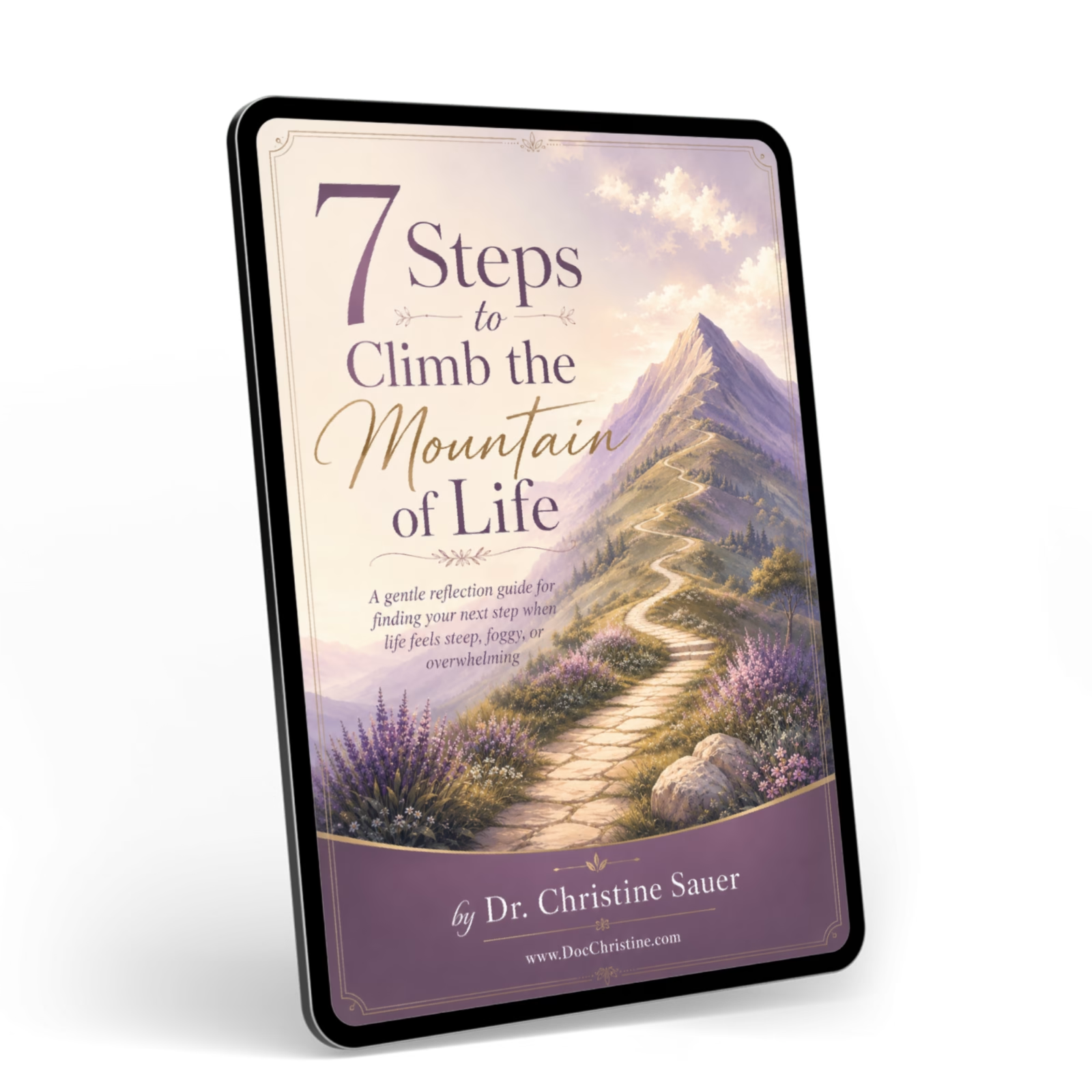
The Sparkle Path: 7 Steps for Personal Growth and Meaning
Find Your Personal Growth Journey
If you feel lost, emotionally exhausted, or unsure what comes next, personal growth does not have to mean fixing everything at once. The Sparkle Path is a seven-step personal growth journey for finding orientation, rebuilding hope, and choosing one next true step on your Mountain of Life.
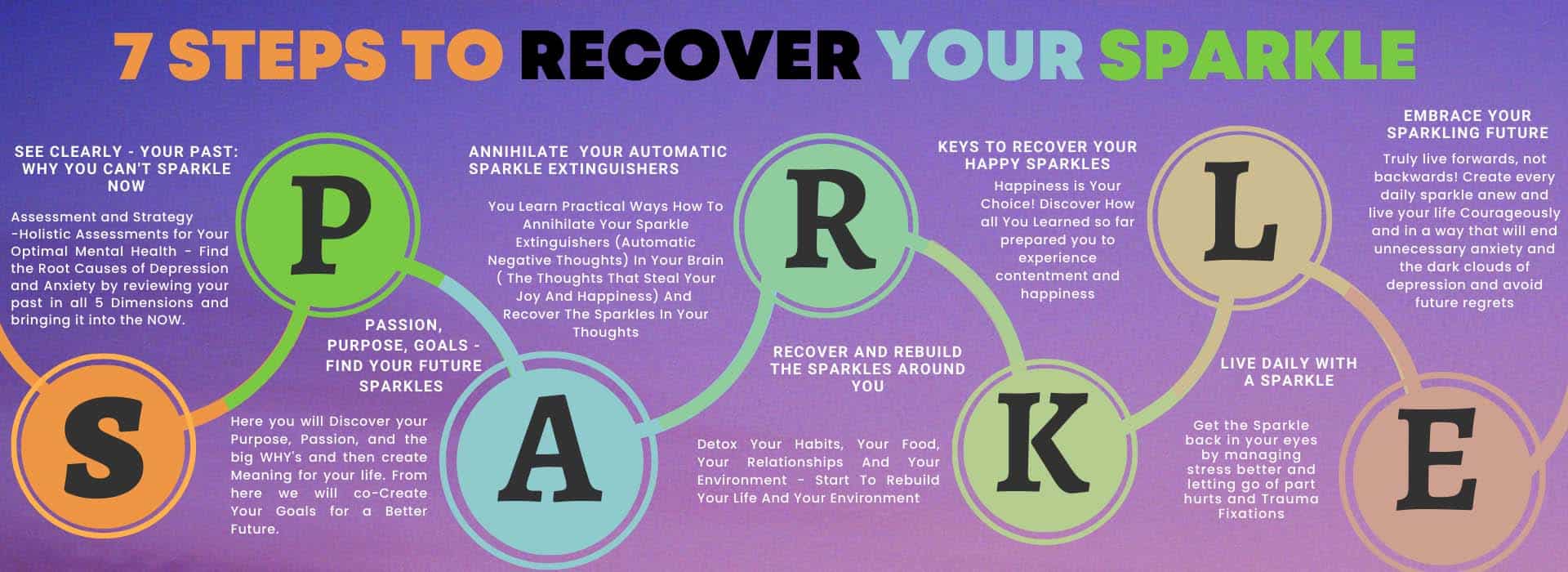
The Sparkle Path is a whole-person framework for personal growth, hope, and meaningful change. It helps you understand where you are, identify what is dimming your sparkle, rebuild the foundations that support you, strengthen emotional resilience, and move toward a future that feels more authentically yours.
- S — See Clearly: Understand where you are and what you are carrying.
- P — Discover Purpose and Possibility: Reconnect with meaning and imagine that change is possible.
- A — Address the Extinguishers: Identify what is draining your energy, hope, health, or sense of self.
- R — Recover and Rebuild: Strengthen the foundations that support your brain, body, relationships, and daily life.
- K — Develop the Keys to Emotional Resilience: Learn how to face difficulty without being destroyed by it.
- L — Live Daily With Sparkle: Turn insight into small, meaningful daily choices.
- E — Embrace Your Sparkling Future: Move toward the life that is calling you, one next true step at a time.
You do not need to complete these steps perfectly or in a rigid order. The Sparkle Path is a map, not a prescription.
You Are Not Broken—and You Are Not Alone
It is the quiet belief many people develop that this is all there is now.
That their suffering is permanent.
That their brain is broken.
That their future will be smaller, flatter, more numb.

In some places in the world, euthanasia or assisted dying is legally available in rare cases when severe depression is the person’s sole underlying medical condition. I have also spoken with patients who told me that MAID was explicitly suggested to them when they questioned or rejected the treatment being offered. This remains ethically and clinically controversial.*
I believe — deeply — that if many of these people had met one truly compassionate, present human being, the story could have unfolded differently.
I know this because I was once in a place where hope was thin — and someone walked with me instead of giving up on me.
That made all the difference.
Sparkle is not happiness. It is orientation.
When people hear the word sparkle, they sometimes think it means constant positivity.
It does not.
If you wonder what it means to sparkle, remember that sparkle is not about feeling good all the time. It is about having a direction, even when things hurt—especially when you have forgotten how to feel like yourself. It is about having a direction, even when things hurt, especially when you forgot how to feel like yourself again.
Like stars in the night sky, sparkle does not remove darkness —
it gives you something to walk toward.
A quiet sense that:
- this suffering is not meaningless
- this moment is not the end of your story
- there are still paths you have not been shown yet
As the old saying goes:
“If you’re going through hell — keep going.”
The Sparkle Path: A Map, Not a Prescription
The Mountain of Life is different for every person.
Some people begin their climb with sturdy boots, a light backpack, experienced guides, and a clear trail. Others start in the fog, carrying wounds, responsibilities, losses, health problems, or burdens they did not choose. Some discover that they have been following someone else’s map—or climbing a mountain they never truly wanted to climb.
That is why the Sparkle Path is a map, not a prescription.
A map can help you understand where you are, what kind of terrain surrounds you, and which directions may be open. It can show you possible routes, places to rest, and hazards worth noticing. But a map cannot climb the mountain for you, and it cannot decide which path is right for your life.
Before rushing toward solutions, it helps to ask four questions:
- Where am I now?
- What am I carrying?
- What kind of terrain am I facing?
- What kind of help would fit this part of the journey?
These questions matter because difficulties rarely exist in isolation. A person may appear to have an emotional problem while also living with chronic pain, poor sleep, loneliness, financial stress, medication effects, grief, or a profound loss of meaning. Addressing only one symptom may provide temporary relief while leaving the larger landscape unchanged.
The Sparkle Path therefore looks at your life through the five dimensions of whole-person health:
- Physical health: your body, brain, sleep, nutrition, movement, medical conditions, medications, energy, pain, and physical environment.
- Mental and emotional health: your thoughts, emotions, beliefs, memories, habits, fears, coping patterns, self-worth, and ability to regulate stress.
- Social health: your relationships, family, friendships, community, roles, boundaries, belonging, and access to trustworthy support.
- Spiritual health: your values, faith, purpose, meaning, moral compass, connection with God or something greater than yourself, and your understanding of why your life matters.
- Financial health: your access to food, shelter, health care, transportation, education, security, and the practical resources needed to make meaningful choices.
These dimensions are distinct, but they are never entirely separate. Financial insecurity can disturb sleep. Poor sleep can intensify anxiety. Chronic pain can limit social contact. Loneliness can affect physical and emotional health. A loss of purpose can make even simple daily actions feel unbearably heavy. In the same way, improvement in one dimension can create new strength in the others.
You do not need to bring every dimension into perfect balance before you can move forward. Sometimes one urgent problem needs attention first. At other times, several small changes work together to make the climb easier.
Nor do you have to follow the Sparkle Path in a rigid order. You may return to an earlier step with new insight. You may rest in the hut for a while, change routes, lighten your backpack, ask for a rope partner, or discover that the goal you once pursued is no longer yours.
None of this means that you have failed.
It means you are responding to the mountain as it is—not as someone else thinks it should be.
The Sparkle Path offers orientation, questions, and possibilities. You remain the person who chooses the route, the pace, the support, and the next true step.
The 7 Steps of the Sparkle Path
Step 1: See Clearly
Personal growth begins with orientation.
Before deciding where to go, pause and ask: Where am I now? What has happened? What am I carrying? What kind of terrain am I trying to cross?
When you are anxious, depressed, grieving, burned out, or overwhelmed, everything can blur together. You may know that something is wrong without being able to name it. You may blame yourself for struggling when the real problem is that you are exhausted, injured, unsupported, carrying too much, or trying to climb a mountain that was never yours.
Seeing clearly does not mean judging yourself or analyzing every mistake. It means becoming curious about your life.
Notice what hurts, but also notice what still helps. Look at your physical health, emotional life, relationships, responsibilities, environment, beliefs, losses, strengths, and sources of meaning. You are not a diagnosis, a failure, or a problem to be fixed. You are a whole person traveling through a particular part of the Mountain of Life.
Clarity may not immediately show you the entire path. It can, however, help you recognize where you are standing—and that is where every meaningful journey begins.
Reflection question: What is true about my life right now, without blame or exaggeration?
Your next true step: Write down three things you are carrying and one source of support that is still available to you.
Step 2: Discover Purpose and Possibility
When people lose their sparkle, they often lose more than happiness. They lose their sense of direction.
Purpose does not need to be a grand mission, impressive achievement, or perfectly defined calling. In a difficult season, purpose may simply mean caring for someone you love, tending a garden, creating something honest, learning a new skill, serving your community, deepening your faith, or becoming the kind of person you needed during your own hardest days.
Possibility begins when you allow yourself to consider that your present circumstances may not be the final chapter of your story.
You do not need certainty. You only need enough openness to ask: What might still be possible?
This can be difficult when disappointment has taught you not to hope. Hope may feel dangerous because you do not want to be hurt again. But genuine hope is not pretending that everything will work out exactly as you wish. It is recognizing that there may still be paths, people, resources, meanings, and parts of yourself that you have not discovered yet.
Purpose gives you a reason to keep climbing. Possibility helps you believe that another path may exist, even when it remains hidden by fog.
Reflection question: What still matters to me, even now?
Your next true step: Choose one person, activity, value, or responsibility that gives your life meaning and give it ten intentional minutes today.
Step 3: Address the Extinguishers
A sparkle rarely disappears for only one reason.
It may be dimmed by poor sleep, chronic stress, grief, illness, pain, nutritional deficiencies, medication effects, financial pressure, loneliness, conflict, trauma, discouragement, or years of putting everyone else first. Sometimes the problem is not that you lack motivation. You may be trying to function while several forces are draining you at once.
I call these forces sparkle extinguishers.
The goal is not to search endlessly for everything that might be wrong. It is to identify the factors that are most likely keeping you stuck and decide which of them can be addressed safely.
Some extinguishers require medical evaluation or professional support. Others may call for clearer boundaries, practical help, honest conversations, more restorative sleep, a change in routine, or permission to stop carrying something that does not belong in your backpack.
You do not have to address everything simultaneously. Trying to repair ten areas at once can become another source of exhaustion.
Begin with the extinguisher that is causing the greatest harm or the one you can influence most safely. Small improvements in one area may give you enough energy and clarity to work on another.
Reflection question: What is most consistently draining my energy, hope, or sense of self?
Your next true step: Name one extinguisher and identify one person, resource, boundary, or action that could help you address it.
Step 4: Recover and Rebuild
Recovery is not simply the removal of pain. It is the gradual rebuilding of what helps you feel safe, capable, connected, and alive.
This often begins with foundations that appear ordinary: nourishment, sleep, movement, medical care, emotional support, manageable routines, time in nature, meaningful relationships, and moments of genuine rest. These things may not sound dramatic, but mountains are climbed through steady footing rather than occasional heroic leaps.
Rebuilding also means recognizing what has changed.
You may not be able to return to the person you were before illness, loss, burnout, betrayal, or trauma. That does not mean your life is over. It means you may need a different route, a lighter backpack, better equipment, more support, or a new understanding of what strength looks like.
Recovery is rarely smooth. You may take two steps forward and one step back. You may need to rest in the hut before continuing upward. Rest is not the opposite of progress. Sometimes rest is the step that makes further progress possible.
Build slowly enough that your changes can support you. The goal is not to perform recovery perfectly. It is to create a life sturdy enough to hold both difficulty and hope.
Reflection question: Which foundation of my life most needs care or rebuilding?
Your next true step: Choose one small restorative action you can repeat consistently for the next seven days.
Step 5: Develop the Keys to Emotional Resilience
Emotional resilience does not mean never feeling sad, frightened, angry, or discouraged. It means developing the capacity to experience difficult emotions without allowing them to define your identity or determine every choice.
A resilient person can bend without believing they are permanently broken.
Resilience grows through skills such as naming emotions, calming the nervous system, questioning unhelpful thoughts, practicing self-compassion, asking for help, setting boundaries, tolerating uncertainty, and remembering what has carried you through previous storms.
It also grows through relationships. Very few people climb their hardest mountains entirely alone. A rope partner cannot climb the mountain for you, but they can steady you, help you recognize danger, remind you of what you have forgotten, and stay near when the path becomes frightening.
You do not need every resilience skill at once. Different terrain requires different keys. What helps during grief may differ from what helps during conflict, illness, anxiety, or exhaustion.
The goal is not to eliminate emotional pain. It is to become better equipped to meet it with wisdom, support, and compassion.
Reflection question: What helps me remain grounded when strong emotions arise?
Your next true step: Practice one grounding skill today, such as slow breathing, a brief walk, prayer, journaling, self-Havening, or contacting someone you trust.
Step 6: Live Daily With Sparkle
Sparkle is not reserved for major breakthroughs, perfect mornings, or days when everything goes well.
It is built in ordinary life.
You live with sparkle when you notice beauty, express gratitude, tell the truth kindly, keep a promise to yourself, laugh at something absurd, spend time with someone you love, or choose a response that reflects the person you want to become.
These moments may appear small, but they are not insignificant. Repeated choices gradually create patterns, and patterns shape a life.
Living daily with sparkle also means accepting that some days will feel brighter than others. You may have days when you can climb confidently and others when getting out of bed is your courageous next step. Your worth does not change with your productivity, mood, or visible progress.
Rather than asking, “How can I transform my entire life today?” try asking, “What would bring one small sparkle into this day?”
Over time, these small sparkles become trail markers. They remind you that you are still here, still growing, and still capable of participating in your own life.
Reflection question: What reliably brings a small sense of warmth, connection, beauty, or aliveness into my day?
Your next true step: Schedule one small sparkle for today instead of waiting to see whether it happens.
Step 7: Embrace Your Sparkling Future
Eventually, personal growth asks you to look beyond recovery and consider what you want to move toward.
Your sparkling future does not need to resemble anyone else’s version of success. It may be quieter, simpler, slower, or more meaningful than the future you once imagined. It may include new dreams, restored relationships, creative work, service, teaching, adventure, faith, community, or a deeper sense of peace.
You may also need to grieve futures that are no longer possible. Embracing what comes next does not require denying what you lost. Grief and hope can travel together.
You are allowed to change direction. You are allowed to discover that you have been climbing the wrong mountain—or carrying someone else’s expectations in your backpack. Recognizing this is not proof that your journey was wasted. Everything you learned can help you choose your next path more wisely.
You do not need to see the mountaintop from where you stand. Most meaningful futures are built through choices that initially seem small.
Face the direction that feels honest. Gather the support you need. Then take the next true step.
Reflection question: What kind of life would feel more honest, meaningful, and alive to me?
Your next true step: Write one sentence beginning with: “The future I want to move toward includes…”
Over many years, working with patients and clients from very different backgrounds and financial situations, I noticed a pattern in those on the journey to recover your sparkle.
People begin to heal — not all at once, and not neatly — when a few things happen together:
Personal Growth Is Not a Straight Line
1. They are seen as whole humans
Not diagnoses. Not problems to manage.
But people shaped by experiences, losses, biology, relationships, and meaning.
2. They receive informed support
This may include medication, supplementation, counseling, coaching, lifestyle change — or a combination.
There is no single right path.
What matters is:
- informed consent
- understanding options
- pacing change safely
- and not being rushed or dismissed
3. They rediscover meaning — even in suffering
This is where psychology, philosophy, faith, and neuroscience quietly meet.
People like Viktor Frankl, David Burns, Jordan Peterson, and others have spoken — in different ways — about the meaning of suffering.
Not glorifying it.
Not denying it.
But understanding that meaning can keep a person alive when pleasure cannot.
A Careful, Honest Word About Mental Health Treatment and Medication
This matters — and it deserves clarity, not slogans.
I am not anti‑psychiatry.
I am not anti‑medication.
Psychiatric medications can be life‑saving, especially in acute crises.
For some people — including those with severe psychotic illness — they are essential.
What I do question is the prevailing attitude of:
“Just take the pills — this will be forever — and don’t expect much more.”
Many medications are prescribed quickly, often without:
- adequate explanation
- long‑term planning
- or access to consistent, human‑centered counseling
Many people report emotional blunting while taking certain psychiatric medications. Benefits and harms differ from person to person, and concerns should be discussed with a qualified prescriber.
The goal, in my view, is not numbness.
The goal is emotional regulation:
- the capacity for joy
- the ability to tolerate sadness
- and even the strength to sit with despair without being destroyed by it
This is closer to stoic philosophy than modern quick‑fix culture.
My non‑negotiable safety boundary
- Never stop psychiatric medication suddenly
- Never attempt changes alone
- Medical supervision and informed consent are essential
This space exists to support understanding, agency, and dignity — not reckless action.
* A Personal Note About MAID and Severe Depression
For some patients, this is not merely a theoretical possibility or a neutral legal option. I have personally spoken with patients who reported being told words to the effect of, “If you don’t like the treatment, why don’t you get MAID?”
I cannot independently verify every clinical conversation. But I take these reports seriously. A person who is ill, discouraged, disabled, or dissatisfied with the care being offered should not be made to feel that death is the alternative to accepting an unsuitable treatment.
When I was severely depressed, I wanted nothing more than to die. At that time, I could not imagine that my life might become meaningful again. It took many years for me to recover my sparkle, and I believe I might not be alive today if euthanasia for depression alone had been available—and suggested—to me 30 years ago.
My suffering was real. My wish to die was real. But my inability to see a path forward did not mean that no path existed.
I do not support euthanasia or assisted dying when depression is the sole underlying medical condition. My experience reinforces the importance of compassionate presence, careful exploration of options, genuinely informed consent, and preserving hope when a person can no longer see a future for themselves.
Sometimes another human being must hold hope for us until we are able to hold it again.
What the Sparkle Path Offers—and What It Does Not
Sparkle does not promise:
- a cure
- happiness on demand
- or a life without pain
Sparkle offers:
- orientation when you feel lost
- language for what you are experiencing
- permission to keep searching for what works for you
- reassurance that suffering is not the end of the story
There are solutions at every financial level.
There are more paths than most people are ever shown.
And sometimes, the first step is simply this:
Not giving up on yourself — even when you are tired of trying.
Begin Where You Are: Choose Your Next True Step
You do not need to do everything at once.
You do not need to decide anything today.
If you would like quiet support, reflections, resources, and guidance delivered gently over time, you may choose to join the Sparkle email series.
It is not a program.
It is a companion.
Frequently Asked Questions About the Sparkle Path
The Sparkle Path is a seven-step framework for personal growth, emotional resilience, hope, and meaningful change. It uses the Mountain of Life as a metaphor for understanding where you are, what you are carrying, what terrain you are facing, and what kind of help may fit. It is designed to help you see your life as a whole rather than reducing you to one symptom, diagnosis, problem, or difficult season.
The seven steps spell SPARKLE:
- See Clearly
- Discover Purpose and Possibility
- Address the Extinguishers
- Recover and Rebuild
- Develop the Keys to Emotional Resilience
- Live Daily With Sparkle
- Embrace Your Sparkling Future
Together, these steps help you understand your present situation, identify what is dimming your sparkle, rebuild supportive foundations, and move toward a more meaningful future.
No. The Sparkle Path is a map, not a rigid prescription. You may begin with the step that feels most relevant, return to an earlier step with new understanding, or work on several steps together. Personal growth rarely happens in a straight line. Resting, reconsidering your route, asking for help, or taking a temporary step backward does not mean that you have failed.
Begin by making the journey smaller. You do not need to solve your whole life or see the mountaintop. Ask yourself: Where am I now? What am I carrying? What is making this part of the journey difficult? Then choose one small, safe, realistic action. Your next true step might be making an appointment, asking for help, resting, eating a nourishing meal, taking a short walk, or writing down what matters most today.
Recovering your sparkle does not mean becoming cheerful all the time or returning to exactly who you were before a difficult experience. It means reconnecting with your sense of aliveness, identity, hope, purpose, and possibility. Your sparkle may appear as curiosity, courage, creativity, faith, connection, humor, or the quiet belief that your life still matters and another step is possible.
The Sparkle Path considers five interconnected dimensions of health: physical, mental and emotional, social, spiritual, and financial. A struggle in one dimension can affect the others. For example, financial stress may disturb sleep, chronic pain may reduce social connection, and loneliness may affect emotional and physical health. Looking at all five dimensions can help you recognize missing pieces and choose support that fits your whole life.
No. The Sparkle Path does not ask you to deny pain, suppress difficult emotions, or pretend that everything is fine. It encourages honest orientation: seeing both the difficulty of the terrain and the possibilities that may still exist. Hope is not the belief that nothing bad will happen. It is the belief that pain is not the whole story and that a meaningful next step may still be available.
No. The Sparkle Path is an educational and reflective framework, not a substitute for individualized medical care, psychotherapy, diagnosis, or emergency support. It may help you understand your situation, prepare questions, recognize areas that need attention, and participate more actively in decisions about your well-being. Medical symptoms, severe emotional distress, medication concerns, or thoughts of self-harm deserve appropriate professional support.
A note about safety and support
This article is educational and reflective. It does not replace individualized medical care, mental health treatment, diagnosis, or emergency support.
If you are feeling hopeless, thinking about suicide, or worried that you may harm yourself, please reach out for immediate support. You deserve care and compassionate human connection right now.
- In Canada: Call or text 9-8-8 through the 9-8-8 Suicide Crisis Helpline.
- In the United States: Call or text 988 through the 988 Suicide & Crisis Lifeline.
- In the United Kingdom or Republic of Ireland: Call Samaritans at 116 123.
- Elsewhere: Contact your local crisis service or use an international crisis-line directory to find support in your country.
If you are in immediate danger, contact your local emergency services.
About the Author
Dr. Christine Sauer is a German-trained physician, educator, and author whose work focuses on whole-person mental and brain health, lifestyle medicine, emotional resilience, recovery, hope, and meaning. Drawing on both her professional background and lived experience of depression and recovery, she created the Sparkle Path and Mountain of Life frameworks to help people understand where they are and identify their next true step.
Her public work is educational and reflective. It does not provide individualized diagnosis, treatment, or emergency care.
Closing thought
Stars are not visible because the night is gone.
They are visible because it is dark.
If you are here, reading this, there is still a sparkle above you — even if you cannot see it clearly yet.
Keep going.
Resources that may resonate
Many people have found language, clarity, or hope through the work of clinicians and teachers such as:
- David Burns (CBT and compassionate self‑talk)
- Daniel Amen (brain‑based perspectives)
- Joseph McClendon (identity, meaning, and human potential)
- Peter Breggin (critical examination of psychiatry)
These are voices to explore, not rules to follow.
Take what resonates. Leave what doesn’t.
Last Updated on September 18, 2026 by Dr. Christine Sauer