How to Stop Being So Hard on Yourself: A Kinder Next Step
How to practice self-compassion that makes room for responsibility
You reach the end of a long day. You have answered questions, looked after someone, and dealt with several things that were never on your list. Yet your mind settles on the one thing you did not finish.
“What is wrong with me? I should have done more.”
Perhaps you would never speak that way to a tired friend. With yourself, however, the words arrive almost automatically.
If you are wondering how to stop being so hard on yourself, begin with one moment: notice the criticism, separate what happened from what you are calling yourself, and choose a fairer response. Then ask what would actually help you take the next step.

You can practice this gently. There is no need to become perfectly self-compassionate by Friday.
THE SHORT ANSWER
How can I stop being so hard on myself?
To stop being so hard on yourself, notice the critical thought, separate what happened from judgments about your worth, and consider what you are carrying. Choose words that are truthful and kind, then take one helpful step, such as making a repair, resting, or asking for support. Self-compassion leaves room for responsibility.
When self-reflection becomes self-attack
Honest reflection can be useful. “I interrupted someone, and I want to listen more carefully next time” gives you something to work with. “I am a terrible person” leaves you with a painful label and very little direction.
The same thing can happen around productivity. An unfinished task becomes evidence that you are lazy. An awkward conversation becomes proof that nobody likes you. A difficult week becomes a verdict on your whole life.
Notice the size of that leap. A particular event has become a judgment about your worth.
We can acknowledge a mistake, repair what we can, and make a different choice. We also deserve to be treated with basic kindness while doing that work.
What being hard on yourself may look like
Sometimes the pattern is obvious. At other times, it sounds reasonable: “I am only trying to keep myself motivated.” You might recognize it when you:
- Dismiss what you accomplished because something remains unfinished.
- Treat rest as something you must earn by doing enough.
- Replay a mistake long after you have learned what you can from it.
- Expect yourself to manage as much as you did before illness, loss, or additional responsibilities changed your life.
There may be a history behind these expectations. Perhaps you learned early to watch carefully for mistakes, or came to believe that being useful was how you earned acceptance. You may also fear that easing up will mean giving up. These are possibilities to explore, not conclusions anyone can draw about you from a checklist.
Self-compassion leaves room for responsibility
Self-compassion means responding to your own difficulty with care and a willingness to understand it. It includes recognizing that struggle and imperfection belong to being human. You can acknowledge painful feelings without letting them define everything about you. [1]
You might wonder, “If I stop criticizing myself, will I ever change?”
Research offers some encouragement. In a series of experiments, Juliana Breines and Serena Chen found that brief self-compassion exercises could support motivation to improve after a mistake or perceived weakness. In one experiment, participants spent more time preparing for another test after an initial failure than participants who received no intervention. These findings suggest that kindness and effort can work together; they do not guarantee that any particular exercise will help everyone. [2]
Imagine snapping at someone you love. A compassionate response could be: “I was overwhelmed, and I spoke harshly. I need to apologize. I also need to look at what happens when I keep pushing past my limits.”
That response gives you a way to take responsibility and understand what needs attention.
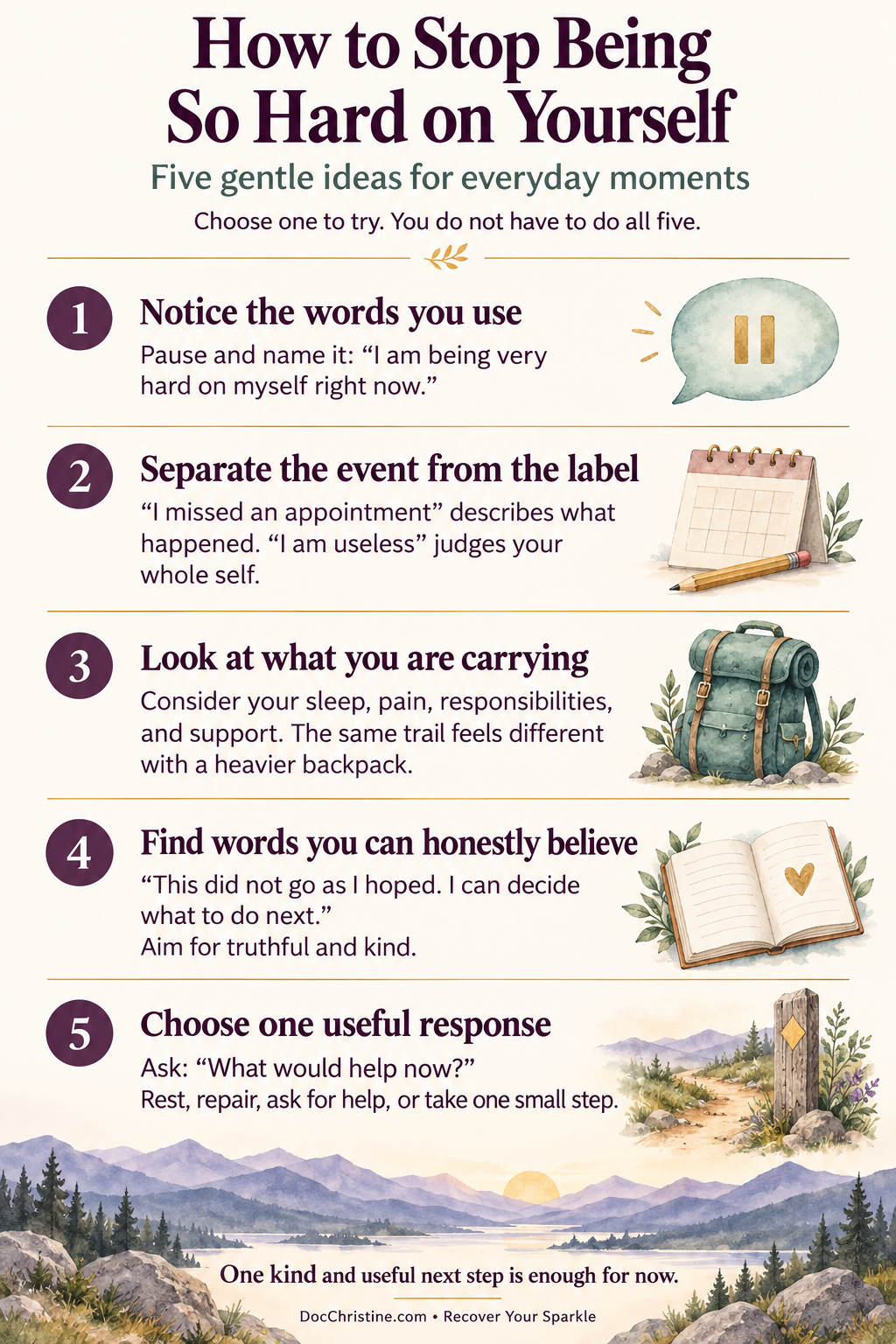
How to stop being so hard on yourself in everyday moments
Choose one of these ideas to try. You do not need to turn them into another list of things you should be doing.
1
Notice the words you use
When you catch an inner attack, pause long enough to hear the sentence. Is it “I made a mistake,” or “I ruin everything”?
You can quietly name what is happening: “I am being very hard on myself right now.” If it helps, write the thought down once. There is no need to examine every thought or argue with your mind until it agrees.
2
Separate the event from the label
Ask yourself what happened in plain, specific language. “I missed an appointment” is a fact you can respond to. “I am useless” is a sweeping judgment.
The appointment may need to be rebooked. You might need a reminder, a different system, or someone to help you organize the next step. Those possibilities become easier to see when you describe the problem accurately.
3
Look at what you are carrying
Before deciding that you should have done more, consider the circumstances. Were you in pain? Had your sleep been interrupted? Were you trying to work while also caring for someone?
Context belongs in an honest assessment of your day.
In Recover Your Sparkle, I use the Mountain of Life to explore the demands of a difficult season. The same stretch of trail feels different when your backpack is heavier. It makes sense to consider the load before deciding how far you should have climbed.
4
Find words you can honestly believe
You do not have to replace “I am a failure” with “I am amazing.” If that feels false, start with something more believable: “This did not go as I hoped. I can decide what to do next.”
Or ask what you would say to someone you care about in the same situation. Aim for a response that is both truthful and kind.
If warmth feels out of reach today, neutral language is a reasonable place to begin.
5
Choose one Helpful response
Once you have named the difficulty, ask: “What would help now?”
The answer might be an apology, five minutes on a task, or a request for help. Sometimes it will be food, rest, or permission to leave a nonurgent job until tomorrow.
Keep the response small enough to fit your actual capacity. A next true step should help you move through this moment, rather than become another test you can fail.
What kinder self-talk can sound like

A KINDER NEXT STEP
Healing takes its own time
When something still hurts, it is easy to turn the calendar into another reason to judge yourself. You do not have to meet a deadline to deserve care.
A fairer response
“This is still affecting me. What support would help me today?”
Your next true step
Choose one kind, useful response: tell someone you trust, make room for rest, or ask for help with what feels difficult.

A KINDER NEXT STEP
The unseen work counts
A list of finished tasks does not tell the whole story of your day. Coping with pain, worry, caregiving, or exhaustion can take effort that no one else sees.
A fairer response
“I did less than I hoped, and I was carrying a lot. What is manageable now?”
Your next true step
Name one thing that took effort today. Then choose a smaller task, ask for support, or make room for rest.

A KINDER NEXT STEP
You can make a new plan
When you cannot follow through as planned, you can acknowledge the impact without turning it into a verdict on your worth. Responsibility can include an honest conversation and a realistic adjustment.
A fairer response
“I did not follow through as I intended. What can I repair, and what can I realistically offer now?”
Your next true step
If someone was affected, acknowledge it and apologize where needed. Then agree on one manageable next step instead of making another promise you may struggle to keep.
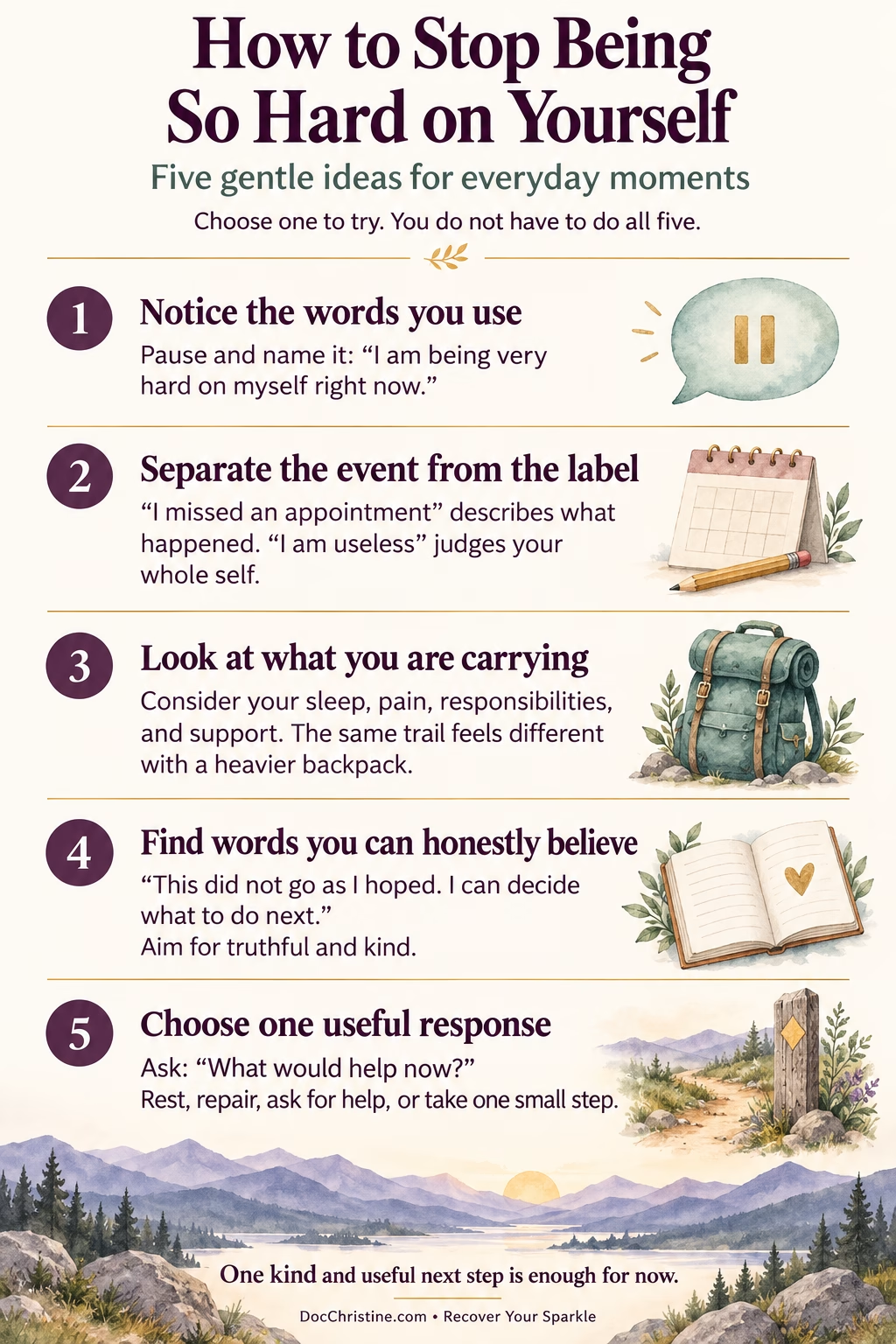
How to stop being so hard on yourself: saveable infographic
Keep these five gentle reminders nearby for moments when your inner critic gets loud. Save the infographic for yourself or share it with someone who could use a kinder next step.
Know someone who is being hard on themselves?
Share this gentle reminder with them. You’re welcome to save and share the infographic unchanged, keeping DocChristine.com visible. Please include the link to this article so others can read the full guidance.
The aim is to make room for a more complete account of what happened, including your limits and your choices.
Let the practice be imperfect
You may notice the criticism only after a difficult afternoon. You may find kinder words and still feel upset. You may need to return to the same situation several times.
A small randomized trial of an eight-week Mindful Self-Compassion program found improvements in self-compassion and well-being compared with a waiting-list group. The study involved 52 adults, mostly women, so its findings have limits. It also studied a supported program over several weeks, rather than the effect of reading an article or trying one exercise. [3]
Give yourself room to learn. If an exercise brings up distress or feels overwhelming, you can stop and seek support. You do not need to push through it to prove you are trying hard enough.
When you need more support
If self-criticism is persistent, feels unbearable, or is affecting your relationships or everyday functioning, consider speaking with a qualified mental health professional. You deserve help with the whole situation, including circumstances that may need to change.
If you are unsure where to begin, my Mental Health Help and Support page offers starting points. You can also ask someone you trust to help you make the first contact.
Questions about self-criticism and self-compassion
Start with the question that sounds most like your day.
Why am I so hard on myself?
Self-criticism can become a learned habit, especially if you came to believe that mistakes threaten acceptance or that harshness keeps you motivated. High expectations and fear of failure may also play a part. There is no single explanation for everyone. Begin by noticing when the criticism appears and what it demands of you. [4]
How do I stop beating myself up after a mistake?
Describe the mistake specifically, without labeling your whole self. Ask what is yours to take responsibility for, what can be repaired, and what would help you respond differently next time. For example: “I missed the appointment. I can rebook it and set a reminder.” Repeated punishment is not a repair.
How can I be less hard on myself at work or when I get less done?
Compare your expectations with your actual workload, resources, and capacity. Include interruptions, caregiving, and the effort that does not appear on a finished-task list. Choose one realistic priority. If the workload exceeds what you can manage, discuss priorities, deadlines, or support rather than treating the gap as a personal failure.
How can I rest without feeling guilty, especially when others need me?
You do not have to wait for guilt to disappear before taking a needed break. Check what truly needs attention now and what can wait. If someone depends on you, arrange a safe handoff where needed. Start with a small, practical pause and notice the expectation that says you must always keep going.
Will self-compassion make me lazy or let me off the hook?
Self-compassion can include accountability, effort, and uncomfortable changes. It means responding to difficulty with care while taking useful action. Research suggests that a compassionate response to mistakes can support motivation to improve. You can apologize, set a boundary, or make a plan without attacking your worth. [2, 5]
What if positive affirmations feel fake or self-kindness feels uncomfortable?
Start with a neutral statement you can believe: “This is difficult,” or “I can decide on one next step.” You do not need to force praise or a warm feeling. A practical act of care can be a beginning. If an exercise increases distress, pause and consider trying it with professional support. [4]
How long does it take to become less self-critical?
There is no fixed timetable. You may catch one harsh thought today and fall into the same pattern tomorrow. That does not erase the practice. Look for small changes, such as noticing sooner, using a fairer sentence, or asking for help. Research on structured programs does not establish a deadline for individual healing. [3]
When should I seek help for self-criticism?
Consider professional support when self-criticism persists, causes substantial distress, or interferes with work, relationships, sleep, or daily life. You do not need to wait until it becomes unbearable. A qualified mental health professional can help you understand the pattern and explore support that fits your circumstances. Visit the Mental Health Help and Support page for starting points.
Your next true step
For today, try completing this sentence:
“I am having a hard time with ______. One kind and useful thing I can do next is ______.”
Choose an answer that fits the person you are today, with the energy and support you have available.
If you would like a little guidance, my free 7 Steps to Climb the Mountain of Life reflection guide offers a gentle place to continue. You will also receive my Sunday Sparkle emails, and you can unsubscribe anytime.
You are allowed to be a person who is still learning, and to receive kindness along the way.
This article offers education and reflection. It does not provide individual diagnosis or treatment or replace care from a qualified health professional.
Research sources
1. Neff, K. D. (2003). Self-compassion: An alternative conceptualization of a healthy attitude toward oneself. Self and Identity, 2(2), 85–101. Read the paper
2. Breines, J. G., & Chen, S. (2012). Self-compassion increases self-improvement motivation. Personality and Social Psychology Bulletin, 38(9), 1133–1143. doi:10.1177/0146167212445599
3. Neff, K. D., & Germer, C. K. (2013). A pilot study and randomized controlled trial of the Mindful Self-Compassion program. Journal of Clinical Psychology, 69(1), 28–44. doi:10.1002/jclp.21923
4. Centre for Clinical Interventions. Building Self-Compassion: information and self-help workbooks.
5. Neff, K. What is self-compassion? Common questions and misconceptions.
Inspiration: Academy of Ideas, Why Self-Criticism Cripples You — and How to Stop It (February 6, 2026).