
How to Feel Like Yourself Again After Stress, Burnout, Illness, or Loss
“I Don’t Feel Like Myself Anymore”
By Dr. Christine Sauer | Physician • Educator - Last Updated: June 2026
Feeling like yourself again does not always mean returning to the person you were before the hard season. It may mean rebuilding safety, energy, clarity, identity, and hope — one small step at a time.
If you do not feel like yourself anymore, you may not be gone. You may be exhausted, overwhelmed, grieving, stressed, or stuck in survival mode. Feeling more like yourself again rarely happens through one big breakthrough. It often begins with understanding what happened, rebuilding enough safety and stability, and taking one small step toward the parts of life that still make you feel alive.
If you have been thinking, “I don’t feel like myself anymore,” you are not alone.
Stress, burnout, illness, grief, caregiving, depression, anxiety, loss or a difficult season can slowly disconnect us from the parts of life that once made us feel alive.
You may still be functioning.
You may still be working, caring for others, answering messages, and doing what needs to be done.
But inside, you may feel flat, tired, far away, exhausted, numb, or unfamiliar to yourself.
That does not mean you are gone. It may mean that too much has happened for too long.
The good news is that feeling more like yourself again does not usually require a complete reinvention. It often begins with understanding what happened, rebuilding enough safety, and taking one gentle next step.
You May Not Be Gone — You May Be in Survival Mode
When people feel disconnected from themselves, they often assume something essential has been lost.
You may think:
“I used to be creative.”
“I used to be brave.”
“I used to be social.”
“I used to have dreams.”
“I used to be fun.”
“I used to feel like me.”

But often, the deeper truth is not that you are gone.
It is that you have been surviving.
When the body and nervous system have been under too much pressure for too long, they may focus less on play, curiosity, imagination, connection, and possibility.
Instead, they may focus on getting through.
You may become more tired.
More watchful.
More anxious.
More numb.
More irritable.
More withdrawn.
You may overthink.
You may avoid things you once enjoyed.
You may find it difficult to make decisions.
That does not mean you have failed.
It does not mean you are weak.
And it does not necessarily mean the real you has disappeared.
It may mean that the real you has been trying very hard to protect you.
Sometimes We Lose Ourselves Little by Little
Not every loss of self comes from one dramatic event.
Sometimes it happens through a thousand small abandonments.
You say yes when you mean no.
You stop resting because there is too much to do.
You stop creating because it seems unproductive.
You stop telling the truth because it feels easier to keep the peace.
You stop asking what you need because everyone else’s needs seem more urgent.
You become the responsible one.
The helpful one.
The strong one.
The one who keeps everything going.
And eventually, you may become so good at functioning that nobody notices how far away from yourself you have drifted.
Perhaps not even you.
This can happen during burnout.
It can happen during caregiving.
It can happen when you are living with chronic stress.
It can happen after illness, grief, a difficult relationship, financial hardship, or years of putting everyone else first.
You may still be getting things done.
You may still look fine from the outside.
But inside, you may feel flat, disconnected, or absent from your own life.
That is one reason Recover Your Sparkle matters.
Sparkle is not about being cheerful all the time.
It is not about becoming perfect, productive, or endlessly positive.
It is about reconnecting with the part of you that can still feel life.
The part that responds to beauty.
The part that knows what matters.
The part that can laugh, love, create, grieve, hope, and choose.
Do You Need to Go Back — Or Become Someone New?
There is something important to understand here.
Feeling like yourself again does not always mean returning to the exact person you were before.
Some seasons change us.
Illness changes us.
Grief changes us.
Parenthood changes us.
Loss changes us.
Age changes us.
A major life disruption can change the way we see everything.
You may not be able to become the exact person you were before the hard season.
But that does not mean your future is smaller.
It may mean you are becoming someone new.
Someone with more depth.
More compassion.
More wisdom.
More truth.
More courage.
More understanding of what really matters.
The goal is not always to go backward.
Sometimes the goal is to carry forward what was true in you — and let it grow into the person you are becoming now.
You may still be creative.
But perhaps in a quieter way.
You may still be caring.
But perhaps with stronger boundaries.
You may still be ambitious.
But perhaps with a different definition of success.
You may still have purpose.
But perhaps it now looks different than the purpose you once imagined.
That is not failure.
That is part of being human.
Why You May Not Feel Like Yourself After Stress, Burnout, Illness, or Loss
There is a question many people carry quietly.
They may say they are tired, stuck, or have lost motivation, confidence, energy, or hope.
But underneath those feelings is often a deeper question:
How do I become myself again?
Maybe you used to feel more alive. You had more energy, laughed more easily, had ideas, cared about things, and knew what mattered to you.
Then life happened.
Sometimes it happens slowly, through months or years of stress, caregiving, overwork, self-abandonment, or putting everyone else first.
Sometimes it happens all at once.
Illness. Burnout. Grief. Depression. Anxiety. A difficult relationship. Financial pressure. A job that took more than it gave. A loss you never fully recovered from.
One day, you look up and realize:
“I do not feel like myself anymore.”
That realization can feel frightening.
But it can also be the beginning of the path back.
6 Gentle Ways to Feel More Like Yourself Again
You do not have to rebuild your whole life today.
You do not have to find your purpose by next Monday.
You do not have to become a new person overnight.
You may simply need to begin noticing what helps you reconnect with yourself, one small step at a time.
1. Ask, “What Happened to Me?”
Before you try to fix yourself, pause.
Do not begin with shame.
Do not begin with self-criticism.
Begin with curiosity.
A Three-Question Reset
These questions are not meant to keep you looking backward forever.
They are meant to help you understand.
Understanding comes before intervention.
You cannot rebuild a life wisely if you do not understand what happened to the old one.
2. Stop Fighting the Version of You That Helped You Survive
Many people become angry at themselves for how they acted during a difficult season.
They criticize the version of themselves who shut down.
Who gained weight.
Who stopped calling friends.
Who stayed too long.
Who did not leave sooner.
Who could not work.
Who could not cope.
Who said yes too often.
Who became afraid.
But the survival version of you was not your enemy.
That person was trying to keep you alive.
Perhaps imperfectly.
Perhaps in ways that created new problems.
But still, they were trying to cope with what felt impossible.
You do not need to pretend every survival strategy was helpful.
But you may need to stop punishing the person who used it.
You may need to say:
Compassion is not an excuse to stay stuck.
It is the ground from which honest change can begin.
3. Rebuild Safety Before You Rebuild Your Identity
When people want their life back, they often try to make huge changes too quickly.
They create a new schedule.
Join a gym.
Start a strict diet.
Buy a planner.
Register for courses.
Make promises.
Set goals.
Try to become a better version of themselves by Monday.
But when a person has been through a hard season, the first need may not be transformation.
It may be safety.
Sleep.
Food.
Medical care when needed.
Support.
A calmer environment.
Clear boundaries.
A little less chaos.
A little more rest.
A place to tell the truth.
Someone who listens.
A nervous system may have difficulty rebuilding trust while it still feels as though it is running from danger.
The first steps may feel small.
They may not look impressive from the outside.
But small steps can become a new foundation.
You do not rebuild a mountain path by sprinting uphill.
You rebuild by placing one steady foot in front of the other.
[Internal link suggestion: Sleep and Mental Health]
[Internal link suggestion: Gut-Brain Connection]
4. Follow One Old Thread of Aliveness
There are often small clues to who you are beneath the fog.
Think about the moments, activities, people, places, or questions that made you feel most alive.
Not necessarily happy.
Alive.
Perhaps it was:
being outside
reading
making something with your hands
talking deeply with one person
helping someone
learning
music
faith
animals
movement
humour
cooking
writing
teaching
quiet
beauty
adventure
These are not childish preferences.
They may be threads leading back toward yourself.
You do not have to rebuild your whole identity at once.
You can follow one thread.
Read one page.
Go outside for ten minutes.
Listen to one song.
Call one person who lets you be honest.
Make one small thing.
Return to one question that matters to you.
The person you are becoming may reveal herself through what still gives you a flicker of life.
5. Take One Small Act of Self-Return
A large part of recovery is learning to trust small actions again.
Not grand declarations.
Not perfect plans.
One act of self-return.
That might be:
making the medical appointment you have delayed
taking a short walk
eating a real meal
saying no without explaining yourself for twenty minutes
asking someone for help
writing down what you are grieving
returning to a creative practice
tidying one small corner of your life
resting without turning rest into another failure
learning something that interests you
doing one thing that makes you feel more like a human being than a machine
Small steps matter because they quietly tell your brain:
“I am still here.”
“I can still choose.”
“I am worth caring for.”
“There may be a path.”
Sometimes the first sparkle is not joy.
Sometimes it is the smallest decision to participate in your own life again.
6. Let the New You Emerge
There may be parts of you that are meant to return.
Your humour.
Your tenderness.
Your curiosity.
Your love of learning.
Your ability to care deeply.
Your courage.
Your sense of purpose.
But there may also be parts of you that are new.
A clearer voice.
Stronger boundaries.
A different definition of success.
A deeper relationship with faith.
More compassion for people who struggle.
A willingness to live more honestly.
A better understanding of what your body and soul can no longer afford to ignore.
This is why growth is not a ladder.
We do not simply climb up and leave the old questions behind.
We meet them again.
But we meet them with more awareness.
More tools.
More humility.
More truth.
The avalanche may be familiar.
But the climber changes.
The Mountain of Life: Fog Does Not Erase the Path
I often think of life as a mountain climb.
There are seasons when we walk steadily.
There are seasons when the sun is out and we can see the path.
There are also avalanches, crevices, storms, and long stretches of fog.
When you are in fog, you cannot see the whole mountain.
You may not even see the next bend in the trail.
That can make you believe there is no path.
But fog does not erase the path.
It only makes it harder to see.
Sometimes becoming yourself again is not about finding a completely new identity.
Sometimes it is about clearing enough fog to see the next step.
Sometimes it is about resting until you have the strength to take it.
Sometimes it is about asking another person to walk beside you for a while.
And sometimes it is about noticing the small painted stones that tell you:
Someone has walked here before.
There is still a way forward.
You can still recover your sparkle.
If you need help orienting yourself on the Mountain of Life, The Sparkle Path provides a seven-step map for recognizing where you are and choosing one gentle next step.
Start With One Gentle Next Step
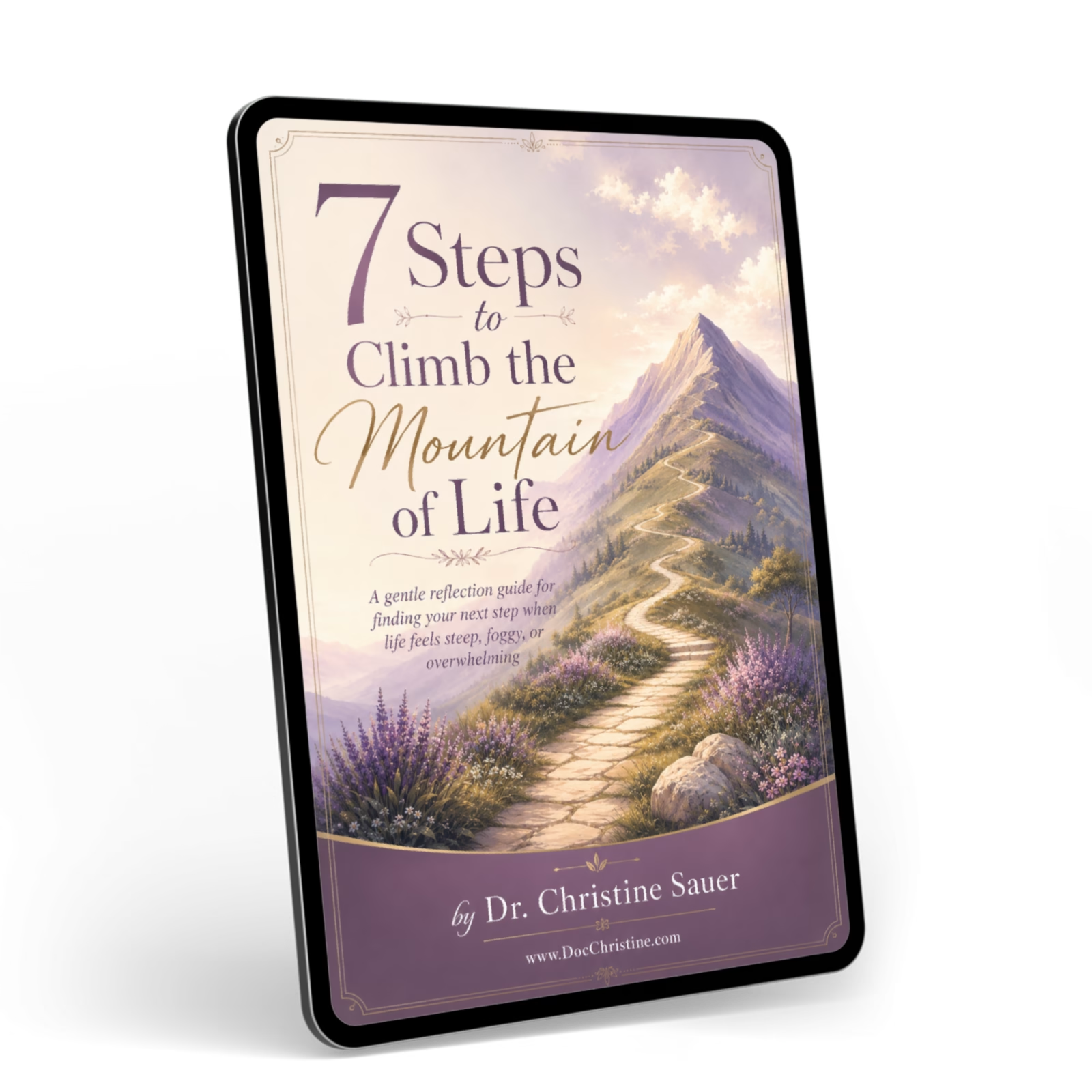
If your sparkle feels dim right now, you do not need to fix your whole life today.
You only need a next step.
My free guide, 7 Steps to Climb the Mountain of Life, helps you pause, reflect, and find a gentle next step when life feels steep, foggy, or overwhelming.
When to Reach Out for More Support
There are seasons when self-reflection and small habits are helpful, but not enough on their own.
If you feel unable to stay safe, are having thoughts of harming yourself, cannot function in daily life, or feel overwhelmed by depression, anxiety, grief, trauma, pain, or substance use, reaching out for professional or emergency support can be an important next step.
Asking for help is not failure.
It may be the first threshold.
If you are in immediate danger or feel unable to keep yourself safe, contact emergency services or a crisis service in your area right away.
A Gentle Safety Note
Sometimes feeling unlike yourself is connected to stress, burnout, grief, illness, or a difficult season. But if you feel unable to stay safe, are having thoughts of harming yourself, cannot manage daily life, or feel overwhelmed by depression, anxiety, trauma, pain, or substance use, please reach out for immediate professional or emergency support in your area.
Asking for help is not failure.
For many people, it is the first important step back toward safety, support, and hope.
A Gentle Question to Carry
You do not have to answer this quickly.
You may want to write it somewhere, carry it for a while, or return to it when you are ready:
What is one small thing I could do this week that would help me feel a little more like myself?
Not perfectly yourself.
Not the old version of yourself.
Not the person you think everyone expects you to be.
Just a little more connected to the person you are becoming.
That is enough.
That is a beginning.
And beginnings matter.
Frequently Asked Questions
People can feel disconnected from themselves after prolonged stress, burnout, illness, grief, depression, anxiety, caregiving, major life changes, or seasons of emotional overload. It does not always mean the real you is gone. Sometimes it means you have been living in survival mode for too long.
Start small. Ask what happened to you, rebuild basic safety and stability, look for one old thread of aliveness, and take one small act of self-return. You do not have to rebuild your whole identity at once.
Yes. Long periods of stress can leave people feeling tired, numb, overwhelmed, less interested in things they once loved, or disconnected from their usual personality and energy. Support, rest, safety, connection, and small sustainable steps can help people begin reconnecting with themselves.
You may not need to become exactly who you were before. Some life experiences change us. The goal may be to carry forward what was true in you while allowing a wiser, stronger, more honest version of yourself to emerge.
No. Asking for help can be a sign that a part of you still wants support, safety, and a path forward. For many people, it is the first important step toward recovery.
Final Thought
You may feel lost.
You may feel dim.
You may feel as though life has carried you far away from the person you once were.
But a tunnel is not the whole road.
Fog does not erase the path.
An avalanche does not erase the mountain.
And you are not required to reach the summit today.
You are only asked to notice the next painted stone.
Take the next step.
Receive help when you need it.
And keep becoming.
Your sparkle may be dim.
But it may not be gone.
It may be waiting for enough safety, space, truth, and kindness to return.
Ready for a Gentle Next Step?
You do not need to solve your whole life today.
Sometimes the next step is simply to pause, see where you are, and begin again with a little more clarity.
My free 7 Steps to Climb the Mountain of Life guide can help you reflect on what you have been carrying, where you may be on the path, and what one gentle next step could look like for you.
Start Where You Are:
7 Steps to Climb the Mountain of Life
Get the guide and take one gentle next step today.
You’ll also receive occasional educational emails from Dr. Christine Sauer about emotional wellness, resilience, brain health, and Recover Your Sparkle. You can unsubscribe anytime.
Last Updated on September 18, 2026 by Dr. Christine Sauer