10 Years Of Life Wasted By Depression?
Why I No Longer See Those Years as the End of My Story
By Dr. Christine Sauer | Physician • Educator | Updated July 2026
If you feel unsafe, suicidal, or unable to cope, please seek urgent help now through local emergency services, a crisis line, or a qualified healthcare professional. In Canada: call or text 9-8-8. In the U.S.: call or text 988.
For many years, I believed depression had stolen more than a decade of my life. It brought suffering, loss, confusion, and a long season when I did not feel like myself.
I would never tell someone in deep pain that they should be grateful for what they are going through. But over time, I began to see something else.
Those years were not the end of my story. They changed me. They taught me about resilience, meaning, compassion, and the quiet ways a person can begin to come back to life.
This is my story of moving from darkness toward hope—and of learning that even when your sparkle feels buried, it may not be gone.
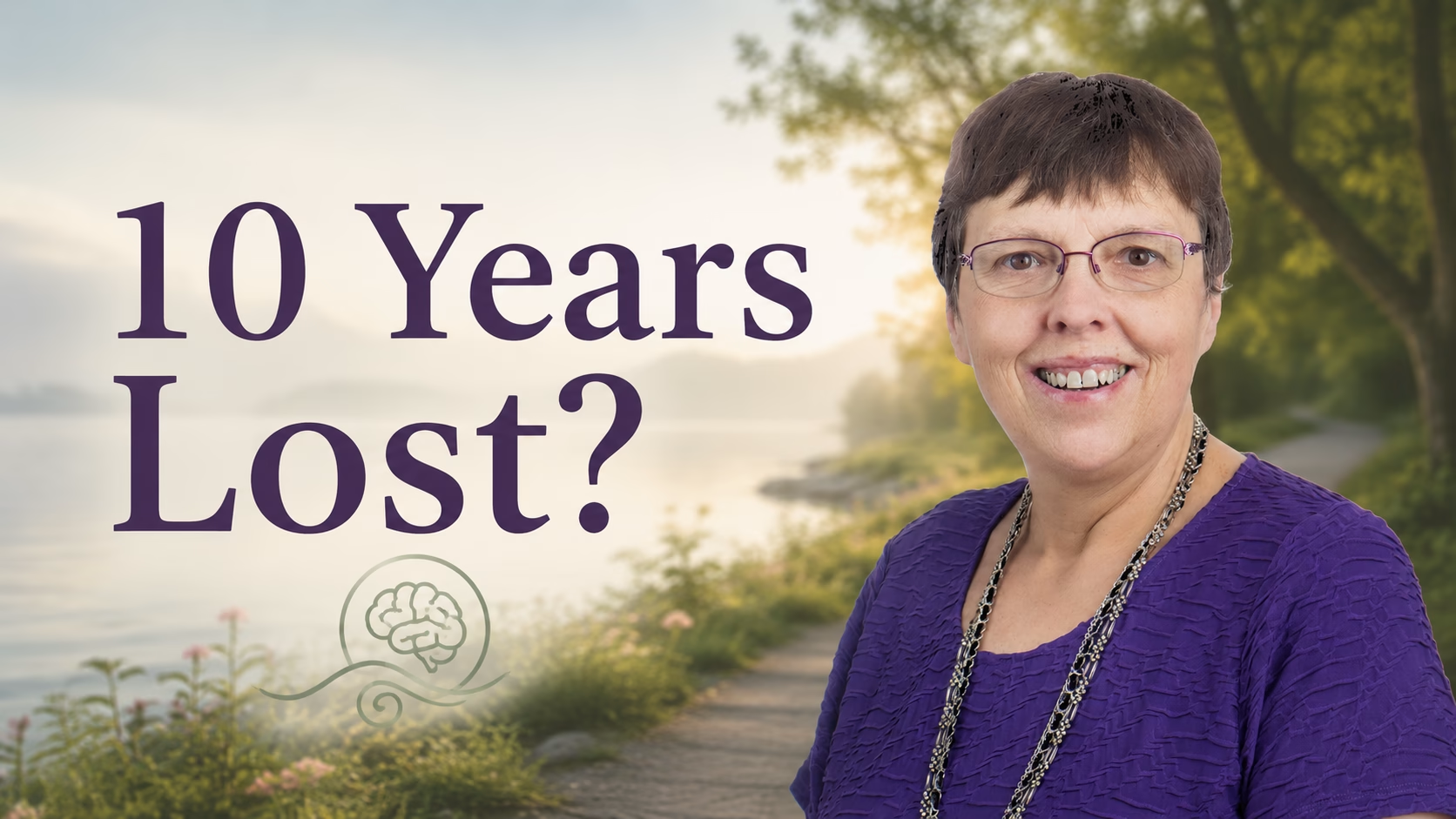
Click to play
For many years, I grieved what I believed depression had taken from me.
I believed depression had taken more than a decade of my life.
I thought those years should have been spent building my medical career, helping more people, reaching more goals, and becoming the person I thought I was supposed to be.
When I looked back, I often saw only loss.
- Lost opportunities.
- Lost confidence.
- Lost health.
- Lost time.
If you have struggled with depression, burnout, chronic illness, grief, or another difficult season of life, perhaps you know that feeling.
Maybe there is a chapter of your life that still feels lost.
A season you wish had never happened.
A period of suffering that still seems impossible to make sense of.
If so, I understand.
And I want to encourage you to keep reading.
Because over time, I began to discover something that changed my perspective—slowly, not all at once.
Not all healing is visible while it is happening.
Some of the lessons I now hold most dearly about resilience, compassion, meaning, and what it means to be human emerged during years I once wished had never happened.
That does not make the suffering easy.
It does not mean I would choose to repeat it.
But it does mean I no longer see those years as wasted.
Today, I feel grateful for the understanding that took so long to earn—and for the chance to use what I learned to help other people find hope in their own difficult seasons.
This Was The Darkest Night Of My Life
This next section includes a brief personal account of suicidal despair and hospitalization. You do not need to read the details to receive the message of this article. If you feel unsafe now, please seek urgent support through local emergency services, a crisis line, or a qualified healthcare professional.
It was a cold winter day in February 1998.
I was lying on a thin mattress, curled in the fetal position, in a small tiled room. There was no furniture and no distraction—only a thin blanket, a hole in the corner of the room, and a locked steel door.
Every so often, someone lifted the flap in the door to check on me.
I was not in jail. I had been placed there for my own protection.
At that time, my mind had spiralled into a place I could no longer navigate safely on my own. The emotional pain was unlike anything I had experienced before. It felt endless. It felt hopeless.
I was convinced that the only way to escape that pain was to end my life.
Looking back, I understand that depression had profoundly distorted my thinking. But at the time, what I saw felt completely real.
The people caring for me made a difficult decision. They protected me from myself when I could not yet see a future worth protecting.
They believed this darkness could pass. And they believed I was worth protecting until it did.
More than two decades later, I remain deeply grateful to the physicians, nurses, mental-health professionals, and hospital staff who gave me another chance.
They did not solve my life that day. But they kept me here long enough for my story to continue.
When I Was No Longer the Doctor
At that moment, I was no longer the doctor who knew how to help other people.
I was a patient—frightened, exhausted, and unable to imagine a future for myself.
The people caring for me saw what I could not yet see:
At the time, I could not imagine that future.
They could.
Their care did not instantly remove the pain. But it gave me another chance to stay alive long enough to rebuild a meaningful life and discover a purpose I could not yet see.
I am also grateful for the other patients who shared that locked psychiatric ward with me.
We came from different backgrounds, carried different stories, and were facing different forms of suffering. Yet, in many ways, they helped me as much as anyone.
For the first time in a long time, I was no longer the doctor. I was no longer the professional or the person who felt she had to have all the answers.
I was simply another human being who was suffering.
Strangely, there was something freeing about that. The titles were gone. The expectations were gone. The masks were gone.
What remained was something more fundamental: a group of human beings trying to make it through another day.
We walked the same hallways, shared many of the same fears, and searched for the same thing:
Hope.
At the Bottom of My Mountain
I often describe that period of my life as reaching the bottom of my mountain.
Not because I had failed.
Not because I was weak.
But because the identity I had built around achievement, usefulness, and being the person who helped others had fallen away.
The beliefs that achievement creates worth, success guarantees happiness, and helping others somehow protects us from suffering did not survive that season.
What remained was a much more difficult question:
Who am I when everything I use to define myself disappears?
Looking back, I believe that question became one of the most important turning points in my life.
It forced me to begin discovering that my worth was never dependent on my career, my achievements, my productivity, or my ability to meet other people’s expectations.
I was worthy because I was human.
That realization did not heal me overnight. But it eventually became one of the foundations of my recovery.
Labels Can Help — But They Are Not Identity
When I was struggling, I received several psychiatric diagnoses. Over the years, those labels changed as different professionals tried to understand my symptoms and experiences.
At the time, the diagnoses served an important purpose. They helped me access medical care, mental-health services, medication, disability support, and treatment programs I genuinely needed. I remain grateful to the professionals who were trying to help me through a very difficult period of my life.
But over time, I learned an important lesson: a diagnosis can be a useful clinical description. It should never become the whole story of a person.
For a while, I began to see myself through the lens of those labels. I no longer thought of myself simply as a person experiencing depression. I began to think of myself as a depressed person—as though the diagnosis described who I fundamentally was.
Looking back, I believe that made it harder for me to imagine recovery.
Human beings are more complex than any diagnosis, category, or clinical description. We are capable of learning, growing, adapting, healing, and changing.
A diagnosis may describe part of your experience. It does not describe your entire future.
One turning point in my own recovery came when I stopped asking only:
"What label do I have?"
and started asking:
"Who do I want to become?"
That shift did not magically solve my problems.
But it opened the door to hope.
A Dark Night of the Soul
What I experienced was not unique to me. Human beings have always struggled with despair, grief, loss, uncertainty, and seasons when life feels almost impossible to carry.
At some point, I found language that resonated with the depth of what I had been through: a dark night of the soul.
For me, that phrase did not mean I was broken. It did not mean that suffering was good, necessary, or something I should be grateful for.
It described a time when many of my assumptions about myself, my future, and what made life worth living had fallen apart.
And strangely, that became the beginning of rebuilding.
When the old identity had cracked, there was eventually room to ask deeper questions: Who am I beneath achievement? What matters now? What kind of life do I still want to build?
I did not answer those questions quickly. But they became part of the path that led me slowly back toward hope.
What Helped Me Recover my Sparkle
Recovery did not happen overnight.
There was no single breakthrough, miracle moment, book, medication, therapy session, or conversation that suddenly made everything better.
Recovery happened slowly, through many small pieces of support, many imperfect choices, and a gradual willingness to believe that my life might still hold meaning.
Some things helped me become more stable. Some helped me understand myself. Some gave me practical support. Some helped me reconnect with hope, purpose, and the possibility of a future.
What helped me is not a prescription for anyone else. Every person’s path is different.
But these are some of the things that helped me begin to recover my sparkle.
Healing was not a single solution. It was a foundation built slowly through small daily actions, repeated with care over time.
Learning
Learning gave me language for experiences I had not been able to name.
Books, conversations, and thoughtful teachers introduced me to new ways of thinking about suffering, growth, purpose, resilience, relationships, and mental health.
Some of the books that influenced me at different stages included:
• Feeling Good — Dr. David Burns
• Man’s Search for Meaning — Viktor Frankl
• On Becoming a Person — Carl Rogers
• Siddhartha — Hermann Hesse
• Change Your Brain, Change Your Life — Dr. Daniel Amen
Each offered a different perspective on what it means to be human.
They were not a prescription for anyone else. But they helped me ask better questions and begin imagining a future larger than my pain.
Connection and Borrowed Hope
Healing rarely happens entirely alone.
My husband, family members, friends, mentors, healthcare professionals, and supportive communities all played important roles in my recovery.
Sometimes another person carries a little of our sparkle until we can hold it again ourselves.
For a while, I needed other people to believe in a future that I could not yet imagine. Their steadiness, care, and presence helped me remain connected to life until I could begin building that connection again from within.
Sometimes we borrow hope from other people until we are able to generate our own.
Foundations That Supported Me
Over time, I began paying much more attention to the foundations that support both body and mind:
- sleep
- nourishment
- physical activity
- stress and nervous-system regulation
- emotional support
- social connection
- purpose and meaning
These were not quick fixes. They did not erase everything that had happened.
But they helped me create a steadier foundation for daily life. They gave my body and mind more of what they needed to recover, adapt, and begin moving forward.
Reclaiming Agency, One Small Step at a Time
One of the most empowering lessons I learned was that while I could not control everything that had happened to me, I could begin to influence what happened next.
Recovery did not begin when life became perfect.
It began when I started taking small actions despite imperfection: one decision, one habit, one honest conversation, one day at a time.
That was not self-blame.
It was the beginning of agency.
It was the gradual return of my ability to participate in my own life again.
Were Those Years Really Wasted?
For a long time, I believed they were.
I blamed myself. At times, I blamed circumstances, the healthcare system, and depression itself.
But I no longer see those years as a simple verdict on my life.
They were painful. They were confusing. They cost me things I wish I had not lost.
But they also became part of the path that taught me what matters most: that worth is not earned through achievement, that healing is not linear, and that a life can become meaningful again even after a long season of darkness.
That is my story. I would never tell another person that pain was meant to happen, or that they should be grateful for it.
Some losses are simply losses. Some seasons require grief, protection, support, and time.
For me, the deepest shift did not come from finding a perfect explanation or a label that finally seemed to fit.
It began when I slowly stopped seeing myself as only a diagnosis, a patient, my symptoms, or my past.
I began to see myself again as a human being capable of growing, learning, adapting, healing, and changing.
Instead of asking only:
"What is wrong with me?"
I slowly began asking:
"Who do I want to become, even while I am healing?"
That question did not solve everything. But it changed the direction I was walking.
There was also a small part of me—sometimes barely audible—that still wanted to live, learn, and contribute.
In my darkest moment, that part of me reached toward help. Later, other people helped me keep listening to it: my husband, friends, mentors, healthcare professionals, and authors whose books found me at the right time.
They reminded me that human beings are not fixed. We are works in progress.
So, were those ten years really wasted?
For me, the answer is no.
They were painful. I would not choose to relive them. And I will not pretend every loss became a lesson.
But those years became part of the foundation from which I rebuilt: a deeper understanding of suffering, resilience, meaning, compassion, and what it means to be human.
Sometimes We Lose Our Sparkle
One reason I share this story is that I now understand that losing your sparkle is part of being human.
Not everyone experiences depression. Not everyone spends time in a psychiatric hospital or feels they have lost ten years of life.
But many people know what it is like to enter a season that becomes darker, heavier, or more confusing than they expected.
It may be illness, grief, burnout, caregiving, divorce, financial pressure, a dream that did not unfold, or a version of life that changed without permission.
During those seasons, we can lose more than happiness or motivation.
We may lose our sense of possibility, meaning, connection, or even our sense of who we are.
That is part of what I mean when I talk about sparkle.
Sparkle is not forced positivity. It is not constant happiness or pretending life is easy. It is the part of us that can still care, wonder, connect, learn, laugh, hope, create, contribute, or imagine that life might hold something more.
For many years, I believed my sparkle was gone forever. I thought the person I had been before depression had disappeared, and that I had become permanently damaged.
I was wrong.
My sparkle was not gone. It was buried beneath suffering, fear, exhaustion, hopelessness, and beliefs that no longer served me.
As healing slowly occurred, I began to notice small signs of life returning: curiosity, hope, the desire to learn, the desire to help others, and the sense that my life might still hold meaning.
It did not all return at once. It did not return perfectly.
But gradually, one small step at a time, I began to recover my sparkle.
Buried is not the same as gone.
What I Wish Someone Had Told Me Earlier
If I could go back and speak to the woman lying on that mattress in the psychiatric ward, I would not give her a perfect explanation or a five-year plan.
I would simply tell her a few things.
This pain feels endless right now, but you deserve help staying safe until there is more room to see what may still be possible.
You are not broken beyond repair.
A diagnosis may help describe what you are experiencing. It is not your identity, your whole story, or your destiny.
Recovery may take longer than you want. It may not be neat or linear. But small steps still count.
There may still be laughter, love, learning, work, contribution, connection, and meaning ahead of you—even if you cannot see them yet.
You do not need to solve your whole future today.
You only need to find the next safe step.
That is what I would tell her.
And it is what I would gently offer to anyone who is standing in a hard season now: your life may feel smaller today than you hoped it would be, but your story may not be finished.
Recovering Your Sparkle
Today, when people ask why I created the Recover Your Sparkle philosophy, the answer is simple.
I know what it feels like to lose contact with parts of yourself that once felt alive—and to slowly notice them beginning to return.
Recovering your sparkle does not mean becoming happy all the time. It does not mean pretending life is easy, eliminating every symptom, or never facing disappointment again.
It means reconnecting with the parts of yourself that suffering may have temporarily hidden: hope, meaning, purpose, curiosity, connection, compassion, resilience, and the belief that tomorrow may still hold something different.
For me, that return happened slowly.
It appeared first in small signs: curiosity, the desire to learn, the wish to help others, moments of connection, and the growing sense that my life might still hold meaning.
I do not believe recovery follows the same timeline for everyone. But I do believe that people deserve support, dignity, and room to discover what may still be possible.
Your sparkle may feel buried right now.
Buried is not the same as gone.
Your Story May Not Be Finished
When I look back today, I no longer see ten wasted years.
I see ten difficult years. Painful years. Confusing years. Years I would never have chosen.
But I no longer see them as the final verdict on my life.
They taught me humility, compassion, resilience, and a deeper understanding of what it means to be human. They also taught me that healing is rarely a straight line—and that a person can begin rebuilding even after a long season of darkness.
If you are walking through a difficult season of your own, I want you to know this:
The fact that you cannot see a path forward today does not mean there is no path.
The fact that you feel stuck does not mean you will always be stuck.
And the fact that hope feels far away does not mean your story is over.
Sometimes we cannot see the next chapter while we are still living the current one.
More than two decades later, I am still learning, growing, making mistakes, recovering, and discovering new reasons to be grateful.
I remain deeply convinced that no human being should be defined by the worst chapter of their life.
People change.
Healing can happen.
And your story may not be finished.
Where to Go Next
You do not need to solve your whole future today.
You may simply need one clear next step, one helpful resource, or one person beside you while the path becomes visible again.
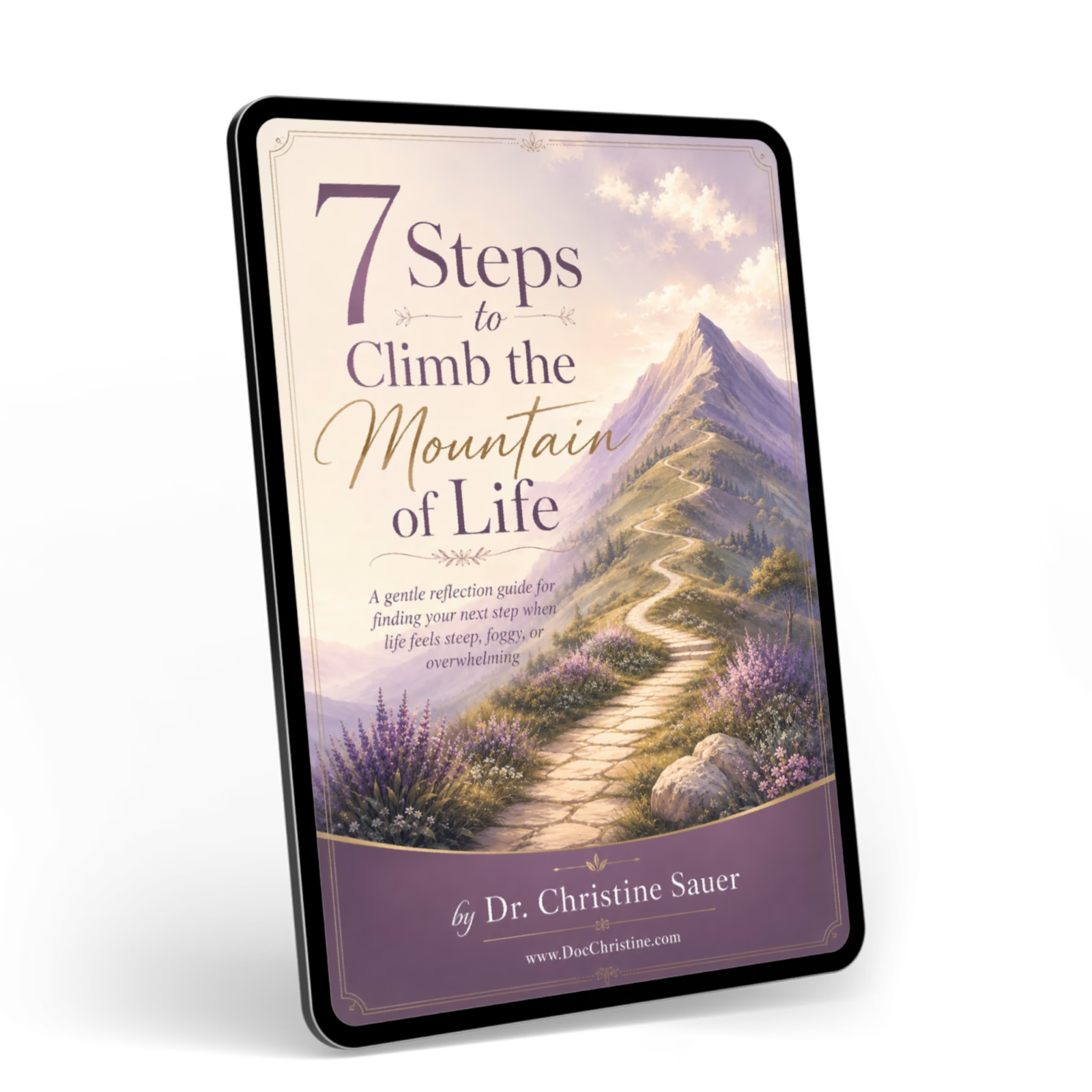
Read The Sparkle Path: 7 Steps for Personal Growth and Meaning
Continue Exploring
If this story resonated with you, you may also find these articles helpful:
Understanding Depression
Root Causes of Depression: A Whole-Person Perspective
Explore some of the biological, psychological, social, lifestyle, and environmental factors that may contribute to depression.
Understanding Anxiety
Understanding Anxiety: Why It Happens and What You Can Do About It
Learn how stress, the nervous system, and modern life can contribute to anxiety symptoms.
Brain Health Foundations
The Foundations of Brain Health
Discover practical evidence-informed strategies that support mood, focus, memory, resilience, and long-term brain health.
The Work of Being Human
The Questions That Shape A Life
Exploring the timeless questions of meaning, purpose, identity, growth, and what it means to be human.
Learn more about depression
For general information about depression, symptoms, and treatment options, see the National Institute of Mental Health’s depression overview.
Frequently Asked Questions
Yes. Many people living with depression experience grief over lost opportunities, relationships, career goals, health, or time. These feelings are common and understandable.
Many people experience significant improvement even after years of struggling. Recovery often involves support, treatment, lifestyle changes, personal growth, meaning, purpose, and time.
Recovery involved many factors, including professional support, education, relationships, lifestyle changes, self-reflection, purpose, and gradually rebuilding hope.
A diagnosis may help guide treatment and access services, but it does not define a person's identity, potential, or future.
Recover Your Sparkle is a philosophy of hope, resilience, healing, and rebuilding after difficult seasons of life. It reflects the belief that emotional vitality, meaning, purpose, and hope can return.
No. Human beings retain the capacity to learn, adapt, grow, and change throughout life. Healing and personal growth remain possible at any age.
This article is educational and reflective in nature and does not provide medical advice, diagnosis, or treatment. This article shares my personal experience with depression, psychiatric hospitalization, recovery, and healing. Individual experiences vary, and my story should not be interpreted as medical advice, diagnosis, or treatment recommendations. If you are struggling with depression, thoughts of self-harm, or a mental health crisis, please seek immediate support from a qualified healthcare professional or emergency service in your area. Recovery is personal, and the path forward may look different for each individual.
Last Updated on September 18, 2026 by Dr. Christine Sauer