
The Pickle Strategy: Emotional Boundaries When Helping Others
How to Help Others Without Becoming Pickled Yourself
The Pickle Strategy is a simple emotional-boundaries tool: separate the real task from the emotional pressure around it, then choose how to help without losing your calm.
You can care without collapsing. You can help without rushing. You can stay kind without letting another person’s stress take over your nervous system or allowing their reactions to violate your emotional boundaries.
The key is to pause, identify the real task, choose what help you can honestly offer, keep your calm, and take one next true step.
Sometimes the trouble is not really the pickles. Sometimes it is the tone. The urgency.
The feeling that someone else’s stress has suddenly been dropped into your lap and is now demanding to become your stress too.
In Sparkly’s mountain world, Sparkly is the gentle alpine marmot with the glowing tail, Alma is his wife and steady mountain partner, and Pesky is the lovable chamois (mountain goat) who sometimes gets overwhelmed faster than he can think.
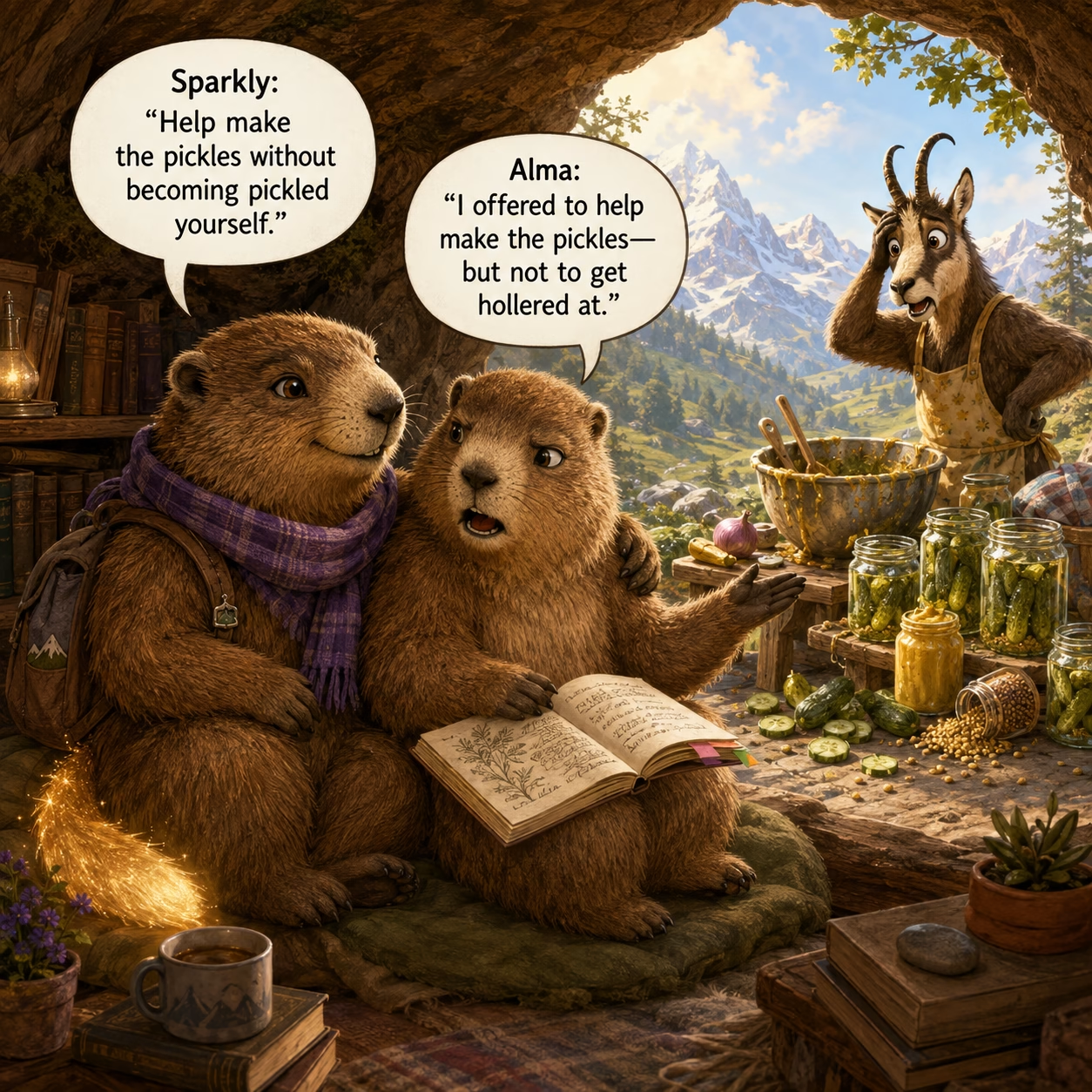
That is what happened when Pesky asked Alma to help make mustard pickles.
Alma agreed. She was willing to help. But she needed to finish something else first.
Pesky, already flustered and behind, did not handle that well. He pushed. He fussed. He was anxious to get the pickles done now.
So Alma stepped away and came back to the peaceful mountain den, upset and hurt.
“I offered to help make the pickles,” she told Sparkly, “but not to get hollered at.”
Sparkly put a gentle arm around her and said:
“Help make the pickles without becoming pickled yourself.”
The Pickle Strategy - A Mountain Tale
Once upon a time, high on the shoulder of the Mountain of Life, where the wind combed the grasses and the clouds rested their tired bellies on the peaks, there lived three unusual friends.
There was Sparkly, the gentle marmot with the glowing tail, who carried a little backpack and watched the mountain weather with kind eyes.
There was Alma, his wife and steady mountain partner, who knew the old ways of herbs, bread, silence, and patience.
And there was Pesky, a lovable chamois — a mountain goat, as some would say — who had a good heart, quick hooves, and a mind that sometimes ran downhill faster than the rest of him could follow.
Now it happened one early fall morning, when the air smelled of frost and woodsmoke, that Pesky came leaping up the stone path with a basket of cucumbers, mustard seeds, onions, jars, and more urgency than one basket should ever carry.
“Alma!” he called. “Alma, I need help with the mustard pickles!”
Alma looked up from her work. She was mending a torn mountain cloak, one that had kept many travelers warm through cold nights. The seam was almost finished, but not quite.
“I will help you,” she said. “But first I must finish this.”
Pesky stamped one hoof.
The cucumbers rolled. The jars clinked. The mustard seeds trembled in their little paper packet as if they, too, feared the hour was late.
“But I need them done now,” said Pesky.
Alma drew the needle through the cloth.
“I heard you,” she said. “I will help. But not this minute.”
Then Pesky, who was not wicked, but who had let worry climb onto his back like a second animal, forgot himself.
“I want you to get this done now!” he cried.
The words flew out sharp. They struck the morning like pebbles against glass.
Alma became very still.
There are times when a person knows that if she speaks too soon, she will not speak from wisdom. There are times when silence is not surrender, but shelter.
So Alma laid down the cloak. She did not shout. She did not throw the mustard seeds into the ravine. She did not tell Pesky that he and his pickles could go live alone in a cave forever.
She simply turned and walked back toward the mountain den.
Inside, the den was cool and quiet. A small fire burned low on the hearth. The old kettle breathed steam. Outside, Pesky muttered among his cucumbers, but inside, the stones remembered peace.
Sparkly was sorting pinecones by the door, because marmots sometimes do such things when the world needs order.
He looked up when Alma entered.
Her face was calm, but her eyes were hurt.
“I offered to help make the pickles,” she said, “but not to get hollered at.”
Sparkly put down the pinecone he was holding.
He came to her side and placed one soft arm around her shoulders.
For a moment, he said nothing. For the mountain teaches that not every wound needs a speech right away.
Then he smiled gently.
“Help make the pickles,” he said, “without becoming pickled yourself.”
Alma looked at him.
Then, despite herself, she laughed.
It was not a large laugh. It was not the laugh of festivals, drums, and dancing under summer stars. It was a small laugh, like the first candle lit in a dark room.
But it was enough.
For the words were funny, and they were true.
There are many brines in this world.
There is the brine of hurry.
The brine of irritation.
The brine of another person’s fear.
The brine of a task that has been left too late and now demands that everyone else suffer for it.
A cucumber may belong in the brine.
But Alma did not.
She sat beside the fire and thought.
The pickles were a real task. Pesky truly did need help. His jars would not fill themselves, and his heart was not bad. He was tangled in his own urgency, as many creatures are.
But the hollering was not part of the recipe.
The pressure was not part of the recipe.
The sharp tone was not part of the recipe.
Alma could help with the cucumbers without drinking the whole jar of Pesky’s panic.
So after a while, when the cloak was mended and her breath had returned to its proper rhythm, Alma rose.
Sparkly walked with her to the door.
Outside, Pesky stood beside the table, looking smaller than before. His ears had lowered. The mustard seeds were still waiting. So were the cucumbers. So were the jars.
Alma came to him and said, “I will help you make the pickles. But I will not be hurried by shouting.”
Pesky looked at the ground.
“I was worried,” he said.
“I know,” said Alma.
“I did not mean to holler.”
“I know that too,” said Alma. “But I still heard it.”
Pesky nodded. This was a difficult truth, but not an unfair one.
Then Alma tied on her apron.
Sparkly climbed onto a flat stone nearby, not to rule over them, but to keep watch over the weather, the jars, and the general dignity of the mountain.
Together they washed the cucumbers. They sliced the onions. They measured the mustard seeds. They heated the vinegar until its sharp scent rose into the air like a little storm that knew its proper place.
Pesky moved more slowly now.
Alma did not hurry.
Sparkly hummed.
And by late afternoon, the jars stood in a row, golden and green and bright, catching the low sun like little lanterns.
Pesky looked at them with pride.
Alma looked at them with satisfaction.
Sparkly looked at Alma and winked.
And from that day on, whenever the mountain folk felt another creature’s panic beginning to soak into their own bones, they remembered the saying from the pickle morning:
Help make the pickles without becoming pickled yourself.
For kindness is good.
Help is good.
Pickles, when properly made, are also good.
But no one should have to lose their peace just because another person forgot where they put theirs.
What this Mountain Tale Story Could Mean...

Alma agreed. She was willing to help. But she needed to finish something else first.
Pesky, already flustered and behind, did not handle that well. He pushed. He fussed. He wanted the pickles done now.
So Alma stepped away and came back to the peaceful mountain den, upset and hurt.
“I offered to help make the pickles,” she told Sparkly, “but not to get hollered at.”
Sparkly put a gentle arm around her and said:
“Help make the pickles without becoming pickled yourself.”
It is a funny line. But it is also a wise one.
Because many of us know this moment very well.
A loved one is stressed.
A co-worker is panicking.
A family member is disorganized.
A friend is upset.
A child is melting down.
Someone needs help, but their urgency comes wrapped in pressure, irritation, or emotional chaos.
And now we have two problems instead of one:
the actual task
and the emotional storm attached to it.
That is where the Pickle Strategy begins.
When Helping Starts to Feel Heavy
Many kind people make the same mistake.
They assume that if they are going to help, they must also absorb the other person’s mood.
If the other person is panicked, they become panicked too.
If the other person is irritated, they become defensive.
If the other person is disorganized, they feel forced to rush.
If the other person is loud, they feel guilty for wanting calm.
But helping is not the same thing as merging.
You can care without collapsing.
You can assist without surrendering your composure.
You can stay kind without letting another person’s chaos take over your nervous system.
That is not cold.
That is not selfish.
That is emotional steadiness.
And emotional steadiness is often one of the most useful gifts you can bring into a tense situation.
How Alma Protected Her Emotional Boundaries
Alma did something very healthy.
She did not retaliate.
She did not explode.
She did not say, “Fine. Do it yourself.”
She did not decide Pesky was terrible and beyond hope.
She also did not pretend that being hollered at was acceptable.
Instead, she stepped back.
That matters.
A pause is not failure.
A pause is often wisdom.
Alma protected something important: her inner steadiness.
She separated two things that often get tangled together:
- the real task
- the unreasonable pressure surrounding it
Yes, the pickles still needed making.
But no, that did not mean Alma had to accept the extra layer of impatience, emotional splashing, or borrowed urgency.
That is a boundary.
And boundaries are not always dramatic. Sometimes they are very quiet.
Sometimes a boundary sounds like:
“I can help, but not like this.”
Or:
“I am still willing to help. I just need a calmer way to do it.”
Or even:
“I need a moment first.”
That is not refusal.
That is self-respect.
Emotional Boundaries Are Not Always a "No"
People sometimes think boundaries always mean saying no.
But often, boundaries mean deciding how and when you can say yes without losing yourself.
That is important, especially for caring, responsible, helpful people.
If you are kind, people may bring you many things:
their need
their confusion
their fear
their hurry
their frustration
their unfinished plans
their emotional spillover
Some of that may be real and understandable.
Pesky is not a villain in this story. He is lovable and overwhelmed. Many of us become less graceful when we are stressed. We get impatient. We get loud. We forget that another person is a person and not a pair of extra hands.
That does not make the behavior wonderful. But it may help explain it.
And understanding where a behavior comes from does not mean allowing it to injure you.
You can have compassion and still hold a boundary.
You can understand that someone is overwhelmed and still decide not to let their overwhelm run your nervous system.
In real life, this may look like:
- helping after you finish what must be finished first
- slowing the pace instead of matching the panic
- lowering your tone instead of rising with theirs
- clarifying what you can do and what you cannot
- stepping away briefly before re-engaging
These are not small things.
This is how people keep their sparkle.
The Mountain of Life View
On the Mountain of Life, not every problem is solved by pushing harder.
Sometimes the wisest next step is not speed. It is steadiness.
If someone is racing in fog, you do not help by racing beside them in the same fog.
If someone drops their backpack and everything spills onto the trail, you do not help by panicking too.
If there is loose rock underfoot, a good guide does not shout, “Faster!”
They help create enough calm to see the terrain clearly.
That is what the Pickle Strategy does.
It helps you remember:
The other person’s urgency is part of the terrain. It does not have to become your identity.
You may still choose to help.
You may still carry part of the load.
You may still join the work.
But you do not have to become emotionally pickled in the process.
You do not have to let another person’s pace, tone, or stress soak all the way into your body and mind.
On the Mountain of Life, one of the most important skills is learning to tell the difference between:
- the mountain itself
- and the panic about the mountain
Those are not the same thing.
What Is the Pickle Strategy?
Here is a simple version you can remember when another person’s urgency starts taking over. The Pickle Strategy will help you to protect your emotional boundaries and your mental wellness.
P — Pause
Do not instantly absorb the emotional tone of the moment.
Take one breath.
Relax your shoulders.
Slow yourself down on purpose.
I — Identify the real task
Ask yourself:
What actually needs to happen here?
Not the emotional drama.
Not the pressure.
Not the commentary.
What is the real task?
C — Choose what help you can honestly offer
Be clear.
- What can you do?
- What do you want to do (or or what really don't you want to do)?
- What can you do later?
- What can you not do well in this moment?
- What do you need to say 'No" to to protect your own emotional boundaries?
Clear expectations and chosen help is better than frantic "help" under pressure.
K — Keep your calm
Let your tone stay steady, even if the other person is upset.
You do not need to mirror their chaos to prove that you care.
L — Leave the borrowed urgency where it belongs
The other person’s stress may be real. But it is still theirs.
You can respond kindly without carrying it as if it were your own.
E — Enter the next true step
Do the next helpful thing.
Not all ten things.
Not the whole mountain.
Just the next true step.
That may be:
- returning to help after a pause
- asking for a calmer conversation
- finishing your first task before starting theirs
- offering one specific kind of help
- deciding that now is not the right moment to engage
- saying gently: "No." (...and nothing after that - it's better to resist the urge to explain yourself.)
The Pickle Strategy is not about becoming hard.
It is about staying clear enough to be useful.
The Pickle Strategy: 6 Simple Steps to Protect Your Emotional Boundaries
P - Pause.
I - Identify the real task.
C - Choose what help you can honestly offer.
K - Keep your calm.
L - Leave the borrowed urgency where it belongs.
E - Enter your next true step.
One Next True Step
Maybe you know this pattern well.
Maybe someone you love often brings urgency, stress or even anger into the room.
Maybe you are the steady one in the family.
Maybe you help everyone and then wonder why you feel drained, snappy, or invisible.
Maybe you say yes with your lips or hands while your nervous system is quietly screaming: "No!."
If so, perhaps your next true step is not to stop helping altogether.
Perhaps it is to help differently.
- More steadily.
- More honestly.
- More clearly.
- With better timing.
- With less emotional absorption.
- With one small boundary that protects your peace.
You do not have to become unkind in order to become clear.
And you do not have to become pickled in order to be helpful.
That is the quiet wisdom in Sparkly’s little sentence.
"You can help make the pickles without becoming pickled yourself."
If that made you smile, good.
If it also made you feel recognized, even better.
Because sometimes one small, funny line helps us see something important:
We can care deeply for other people without losing our own center.
We can help without disappearing.
We can stay warm without becoming porous to every passing storm.
And on the Mountain of Life, that kind of steadiness is not a small skill.
It is part of how we recover our sparkle.
Begin Where You Are

If life has felt heavy, confusing, or emotionally noisy, you do not need to solve the whole mountain today.
Start with one gentle step.
My free guide, 7 Steps to Climb the Mountain of Life, helps you pause, reflect, and find a gentle next step when life feels steep, foggy, or overwhelming.
Related Content:
You can also Start Here, explore more articles, or see what "Recover Your Sparkle" means - for more whole-person guidance, hope, and next true steps.
Frequently Asked Questions
The Pickle Strategy is a simple way to remember that you can help someone without absorbing their urgency, irritation, or emotional chaos.
It means separating the useful task from the pressure wrapped around it. You may still choose to help, but you do not have to become emotionally pickled in the process.
No. The Pickle Strategy is not about becoming cold or selfish.
It is about helping with more steadiness. Sometimes the healthiest boundary is not “I will not help.” Sometimes it is “I can help, but not while being rushed, blamed, or pulled into chaos.”
“Becoming pickled” means absorbing someone else’s stress until it changes your own mood, pace, tone, or sense of self.
You may start calm, but then become rushed, resentful, defensive, guilty, or overwhelmed because the other person’s emotional state has taken over yours.
Yes. It is a gentle boundary.
A boundary does not always mean refusing. Sometimes a boundary means choosing how, when, and under what conditions you can help without losing your own steadiness
That matters. Many people become impatient, loud, or disorganized when they are overwhelmed.
Understanding that can help us stay compassionate. But compassion does not mean we have to absorb the stress. We can understand someone’s struggle and still protect our own calm.
Pause before reacting. Ask yourself what the real task is. Decide what help you can honestly offer. Keep your tone steady. Leave the borrowed urgency where it belongs. Then take one next true step.
You do not have to solve the whole situation at once.
Then pause as soon as you notice.
You can take a breath, lower your tone, step away briefly, or say, “I want to help, but I need us to slow this down.”
Getting pulled in does not mean you failed. It means you noticed the terrain and can choose your next true step.
Recovering your sparkle often includes learning how to stay present without disappearing into other people’s needs, moods, and urgency.
The Pickle Strategy is one small Mountain of Life skill: helping with love, but not losing your own center.
Last Updated on September 20, 2026 by Dr. Christine Sauer