
The Questions That Shape a Life: Why Humans Ask the Same Questions Across Time
Some questions follow us for a lifetime.
- Who am I?
- Why am I here?
- What really matters?
- How do I live with suffering, love, loss, responsibility, and hope?
These questions are not signs of confusion. They are part of being human.
Quick Answer: Why do humans keep asking the same questions across time?
- Because across centuries, cultures, and technologies, the inner life keeps presenting the same thresholds: identity, meaning, love, suffering, responsibility, and the sacred.
- This post explores why recurring human questions aren’t a sign of failure—why modern life often avoids them—and why this conversation matters now.
Quick Answer: Why Do Humans Ask the Same Questions Throughout History?
- Humans keep asking the same questions because the foundations of human experience don’t change: we still wrestle with identity, purpose, mortality, belonging, and moral choice.
- These questions return at life transitions, during crisis, and whenever we outgrow old identities.
- They are signs of development, not deficiency.
Quick Answer: Why Do Humans Ask the Same Questions Across Time?
- Humans ask recurring life questions because we seek meaning, identity, belonging, direction, and hope.
- These questions appear across cultures, religions, philosophy, literature, psychology, and everyday life.
- Questions about love, suffering, purpose, death, responsibility, and freedom help us make sense of being human.
- The goal is not always to find one final answer.
- Often, the questions themselves help us grow.
Four Voices That Help Frame These Questions
To place these questions in context, it helps to listen to a few enduring voices:
- Plato: Philosophy as a way of life—an ongoing practice of examining how we live.
- Genesis 1–3: A story of dignity (“image of God”), self-awareness, rupture, hiding, and the possibility of return.
- Viktor Frankl: Meaning as survival—especially when comfort, certainty, or control are stripped away.
- Carl Rogers: The person behind the problem—healing begins when we meet ourselves with truth and acceptance.
Together, they suggest that recurring questions are not intellectual noise. They are a kind of human compass.
Why These Questions Are Not Failures
Many people quietly assume that if they were “doing life right,” they would be past these questions:
- “If I were healed enough, I wouldn’t doubt myself.”
- “If I were mature enough, I’d know my purpose.”
- “If I were strong enough, I wouldn’t struggle.”
But the recurring questions usually appear because you are growing.
A meaningful life is not a life without questions.
It is a life where the questions refine you—without shaming you.
Modern well-being research also points to the importance of purpose, meaning, and connection in human flourishing; the Greater Good Science Center has helpful resources on research on purpose and well-being.
Why Modern Life Avoids the Big Questions
Modern life is skilled at distraction—often with impressive packaging:
- endless input
- endless optimization
- endless productivity
But the deep questions require things that don’t scale well: silence, time, honesty, and embodied awareness.
Sometimes we avoid the questions not because we don’t care, but because the nervous system is tired—or because asking threatens a structure we built to survive.
If these questions are tangled with fear, stress, or unease, you may also find my guide to understanding anxiety helpful.
The Core Human Questions That Have Moved People for Millennia

Identity & Self
Questions about who we are beneath roles, performance, fear, and expectation.
Purpose & Meaning
Questions about .
Values & the Good Life
Questions about .
Love, Belonging & Relationship
Questions about .
Choice, Responsibility & Freedom
Questions about .
Suffering, Healing & Growth
Questions about .
Spirit, Mystery & the Sacred
Questions about .
Life, Death & Impermanence
Questions about .
Reflection: How to Work With These Questions (Without Forcing Answers)
Instead of trying to “solve” these questions, consider treating them as thresholds. Thoughtful self-reflection questions can help people explore their values, patterns, discomfort, and direction more intentionally.
Ask:
When life feels heavy or meaningless, my page on understanding depression may also be a helpful place to continue.
When We Lose Contact With the Questions
When people lose their sparkle, they often do not only lose energy or motivation.
They may lose contact with the questions that make life feel meaningful.
- Who am I now?
- What matters to me?
- What am I still here to do?
- What kind of life do I want to build from here?
Sometimes recovery is not only about feeling better.
Sometimes recovery means remembering who you are, what you value, what you love, and what still calls you forward.
That is why these questions matter.
They are not abstract philosophy.
They are part of the work of being human.
They help us recover direction.
They help us recover meaning.
And sometimes, little by little, they help us recover our sparkle.
In the spirit of Carl Rogers: healing often begins when we meet the person behind the problem—with honesty and compassion.
Why This Conversation Matters Now
Because in a world that rewards speed and certainty, the deepest human capacities are being neglected:
- discernment
- moral clarity
- self-trust
- reverence
- meaning
These questions are not distractions from “real life.”
They are real life.
If you take nothing else from today, take this:
The ancient questions are not outdated.
They are durable because you are durable.
And when you allow yourself to ask them—without rushing to perform an answer—
you start living from the inside out.
If you’d like a place to continue this kind of conversation in a steady, low-pressure way, you’re welcome to continue this conversation via email.
Until next time:
May your questions become companions—
not accusations.
And these questions become easier to live with when we also rebuild practical foundations for brain and mental health.
If you are not sure where to begin, you can simply start where you are.
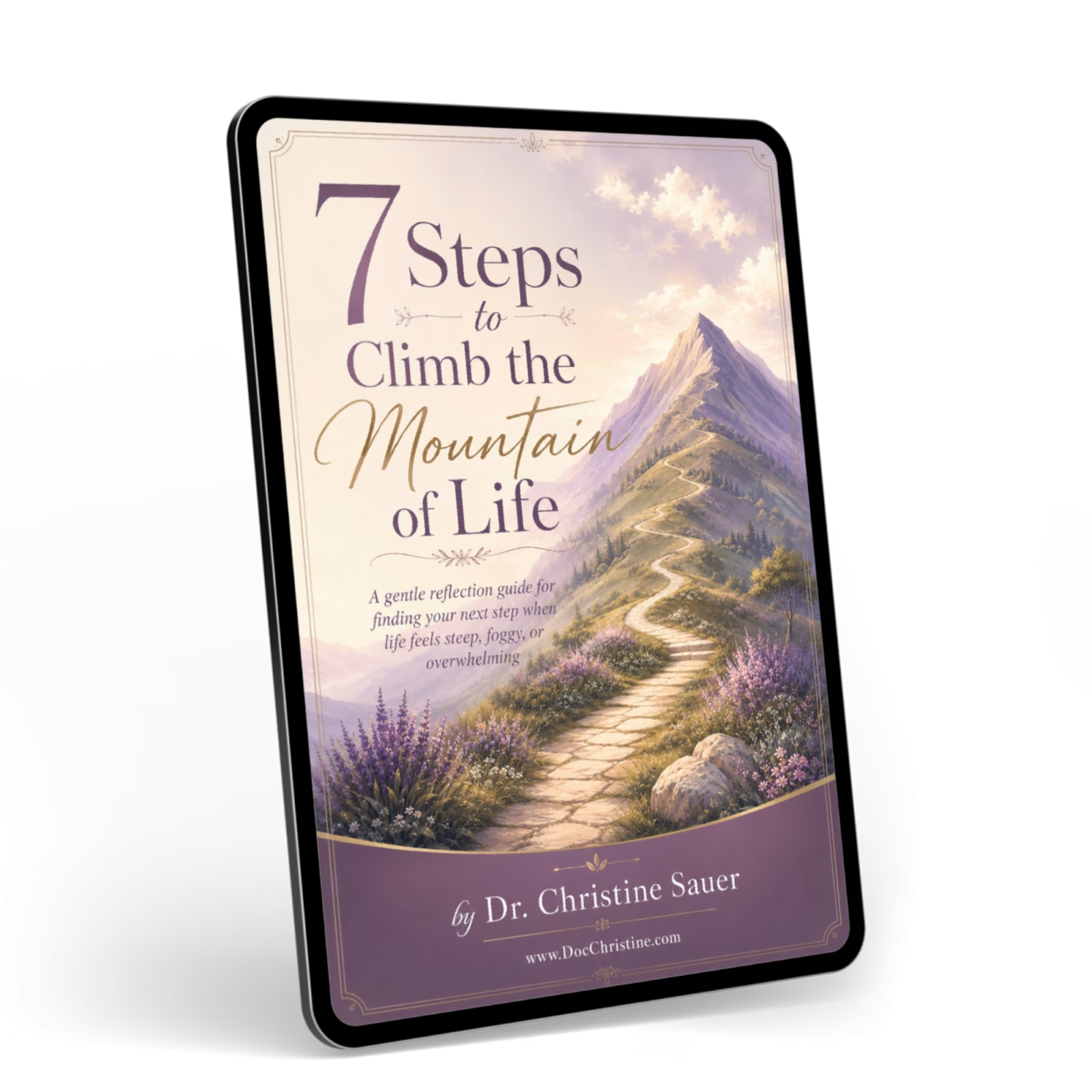
Free Guide: 7 Steps to Climb the Mountain of Life
If this article stirred something in you, you may enjoy my free guide:
Download the free guide:
7 Steps to Climb the Mountain of Life
A gentle reflection guide for people who are rebuilding hope, meaning, resilience, and direction after a difficult season.
You do not need to have everything figured out.
You do not need to see the whole path.
You only need a next step.
You can also explore more articles on brain health, emotional wellness, and the work of being human.
Frequently Asked Questions
Because the core conditions of being human don’t change: we still face identity, love, suffering, moral choice, uncertainty, and death. These questions return whenever we grow, lose something, begin again, or outlive an old version of ourselves.
Not necessarily. Repeating questions often signal development, not dysfunction. The question returns because your life has changed—and the old answer no longer fits.
They cluster around: identity (Who am I?), meaning (Why am I here?), values (What is a good life?), belonging (Where do I fit?), freedom (What can I choose?), suffering (How do I heal?), the sacred (What do I trust?), and mortality (How do I live knowing I will die?).
Modern life rewards speed, productivity, and certainty. Big questions require silence, time, and emotional honesty—things that don’t fit easily into a “busy” culture.
Treat the question as a practice, not a puzzle. Notice what it does in your body, give it time, and take one honest step rather than demanding a final answer. A good question should deepen your life, not paralyze it.
Healthy questions lead to clarity, humility, and grounded action over time. Rumination loops in fear, self-attack, or perfectionism, usually without movement or learning.
Frankl observed that meaning can become a lifeline—especially in suffering. When comfort and control disappear, the question “What is this asking of me?” can help a person endure and respond with dignity.
Rogers emphasized that symptoms and struggles often protect something tender. Healing begins when we meet the person beneath the pattern with truth, acceptance, and compassion—rather than treating ourselves as a project to fix.
Genesis describes dignity (“image of God”) and then the moment of painful self-awareness (“they knew they were naked”). It’s a story about innocence, rupture, hiding, and the possibility of return—without denying human complexity.
Plato treated philosophy as a way of life: examining how we live helps us resist drifting into borrowed values, unconscious habits, and lives shaped by other people’s assumptions.
Yes. Questions about trust, mystery, conscience, and the sacred are human questions. You don’t need a label to explore what you revere, what you serve, and what gives life weight.
Last Updated on June 12, 2026 by Dr. Christine Sauer