Why Pain Is Necessary for Growth, Healing, and Resilience
TL;DR
Pain is not always harmful. Physical and emotional pain may help humans learn, adapt, build resilience, develop empathy, and recognize when change is needed. Some research also suggests that overcoming adversity can contribute to personal growth and emotional strength. However, persistent or overwhelming pain deserves compassionate professional support.
As humans, we all know pain. Edvard Munch illustrated pain beautifully in his dramatic and touching painting (1893): "The Scream"

What Is Pain and Why Do Humans Experience It?
No one likes pain (except for psychopaths).
And many people ask why pain is necessary and if they experience pain, how to relieve it.
Physical pain often originates through an injury, a cut, a bruise, or similar.
Physical Pain vs Emotional Pain
Physical and emotional pain are both unpleasant emotions that demand our attention. They are an attempt of our brain and body to tell us that "something is wrong" - a signal that indicate that there is danger to our existence and that change is needed. As such, they are both invaluable.
What is Physical Pain and Why is Pain is Essential for Life
Physical pain is necessary for our survival and mental pain is essential for our personal growth to mature, content adults and true contentment and lasting happiness.
Let me explain what I mean:
There are rare cases of children born without the ability to feel pain. Sounds wonderful to you? Actually, it is a severe handicap and nearly impossible to survive.
Just imagine you bit your lip or your tongue. You have done it, right? It hurt, and the pain made you stop before you damaged yourself and, for example, bit a piece of your tongue off. No pain = no stopping.
You fell down and broke a bone. The intense pain will stop you from moving more and creating more damage and seeking help. No pain? You will continue to walk on your broken leg until it physically prevents you from moving at all…
You have appendicitis. Your stomach pain alerts you that something is wrong. You see the doctor and get emergency surgery that saves your life. No pain? You die from a ruptured bowel.
These examples make it obvious why physical pain is a good thing and helps us to not only survive, but help the body to heal and seek help when we need it.
That said, once we know the source of the pain, address the cause, or there is no way to address it - as it is chronic pain, like in advanced cancer, pain relief with medications and drugs of different kinds is appropriate and helpful.
Modern medicine has a wide arsenal of them, and I am very grateful for these.
What is emotional pain?
Emotional pain refers to psychological suffering caused by experiences such as grief, rejection, trauma, loss, stress, shame, or disappointment. While painful, these experiences may also contribute to emotional growth, resilience, self-awareness, and behavioral change when processed in healthy ways.
Why Emotional Pain Can Lead to Growth
Emotional Pain comes in many varieties and has many names. It is just as unpleasant and just as important.
We call it sometimes “negative emotions” although, realistically, no emotion is negative.
They are neither negative nor positive.
They may FEEL bad (e.g. hurt and feel unpleasant like fear, guilt, shame or rejection) or FEEL good (aka love, pleasure, acceptance, pride), but in the end, they all are there for a good reason.
Like physical pain compels us to act on it, seek a cause, and, if possible, work on fixing it, so does emotional pain.
the problem with Pain:
We know that our body and brain - our genetic makeup - cannot be changed by natural evolution in a short time (like a few 100s or even 1000s of years) - modern gene technology may change this, and I will not talk about the issues involved with this here.
That said, our brain is still acting like it was 10,000 years ago (or before) to protect us and help us to survive. That we changed our environment and the way we live and communicate in the last 100 years or so, is not relevant to the limbic system (or emotional brain).
Regarding pain, due to our advanced brain development and our ability to “over”-think things, the meaning of our pain (physical or mental) becomes subject to be changed (or manipulated) by what the current time/culture/society we live in tells us it should mean.
The words that we use for our pain give it a flavor towards “good” or “bad” that pain doesn’t naturally possess.
Thus, our choice of words is extremely important.
Is it “unavoidable”, “mild”, “part of the process”, “growing pains”?
Or do you call it “terrible” “excruciating”, “debilitating” or “miserable”?
Can you sense the difference?
These words imply a judgment.
Just take as an example the pain of childbirth, and as a woman who has given birth to 2 children I know well the intense pain involved.
Since mankind existed, the pain of giving birth to a baby was part of being human and needed to be accepted and tolerated as part of life - with a focus on the reward (having a - hopefully - healthy child) that would carry on the survival of the species.
Our brain evolved to assist survival by creating a class of our own neurochemicals (endorphins and others) to help us deal with pain.
In our modern time we developed ways to lessen or nearly eliminate pain, and the pain of giving birth was one of the first applications of general anesthesia when humans discovered chloroform and ether.
Since we know the cause of this pain I feel this was a great advance in medicine and as a woman and human who benefited from this, I am immensely grateful for it.
Modern medicine has a whole array of medicines available that address physical pain.
Most humans would agree with me that this is a true blessing - as long as the cause of the pain is investigated (if at all possible), addressed (if possible with current means) and known.
As a physician, I always have focused on doing exactly this, and alleviating suffering should always be the goal of a physician.
How is the situation when it comes to emotional/mental pain?
Well, in principle, the situation is similar.
Why did our brain evolve to feel unpleasant emotions?
Same reason as for physical pain.
To help us to survive.
Our brain could be called a “survival machine”, if you’d like.
Take fear, for example: Imagine living 10,000 years (or more) ago.
You lived in a cave and went gathering plants, roots and fruits and hunted animals of different sizes for food.
But there were many other plants and animals out there trying the same, and as part of the natural ecosystem, many of these considered YOU as their food and were hunting you.
It is easy to imagine in this situation, that on the sound of a cracking twig or leaves rustling close by, your brain raises fear to alert you of imminent danger.
You have heard of the “stress response” - fear - freeze, flight or flight as your default reactions to avoid situations that could result in severe injury or death.
For social animals that depend on being part of a group for survival (sheep, wolves and humans are examples), being accepted as part of a group is also part of survival.
Not coincidentally, being ejected from your group (= rejected) can still feel like “social death”.
It has been said that in ancient Greece being exiled (= rejected by your group) was worse than physical death…
For most animals living in nature, this situation is still the same.
We humans evolved our brain (the prefrontal cortex especially).
This has given us humans the ability to think before we act (at least if the fear is not too great so we are able to override the automatic “avoidance” reaction).
What Is Post-Traumatic Growth?
How Pain Changes the Brain and Nervous System
Can Avoiding Pain Make Mental Health Worse?
How to Process Emotional Pain in Healthy Ways
When Emotional Pain Needs Professional Support
What the Research Suggests About Pain and Resilience
Final Thoughts: Pain, Meaning, and Human Growth
In the past, how did humans, ancient healers and physicians address emotional/mental pain?
We don’t really know much about this until written records of history have been available, and really, not much is known that would be older than a few thousand years.
Let’s assume us humans always approached this the same way as we do today (as our ancestors were not a bit more stupid as we are)
They tried to address mental/emotional pain the same way they addressed physical pain.
Trying to find a cause, then eliminating the cause, if possible, and if not possible, finding ways to lessen or tolerate the pain.
The ways to do this have changed A LOT…
From fighting the REAL tiger - to avoiding even imaginary threats…
From talking to spiritual clergy or healers and performing familiar ceremonies and rituals
To torturing “witches” in the middle ages that were “speaking in devil’s tongues”
To nowadays prescribing emotionally stunting psychopharmacological drugs long-term even to children, youth and adults on the basis of “diagnoses” like depression or anxiety.
A Word of Caution: Please don’t get me wrong:
I am not against all use of psychopharmacological or psychiatric drugs.
They can be life-saving in certain people, helpful in many, especially if given short-term to bridge a painful situation until better help is available.
Here are a few questions to ponder:
But before we give any drug, medicine or do any intervention long-term, shouldn’t we at least FIRST attempt to find a cause that can be corrected with means other than psychiatric drugs?
The “unruly” toddler that can’t adapt to kindergarten?
Maybe it’s not a deficiency of medications, maybe the parents need more help with practical parenting advice to help her/him eat better food and implement discipline with love and logic - instead of giving them an excuse to sedate their toddler with drugs and possibly cause long-term ill health effects?
The child that can’t focus and pay attention in school?
Maybe he/she is labeled as ADHD / ADD and medicated so they can fit in a school system that may not support their individual learning style or just does not supply them with education around topics that matter in real life (or teachers that cannot make such a topic interesting to children and relate it to real life situations)...
The “chronically depressed” teen that is unhappy being a boy or girl?
Maybe, if we first evaluate and get them help to talk through and address the issues behind it -
When the brain is still developing in children and youth (according to neuroscience, under "ideal conditions" a female brain is fully grown at age 25, and a male brain at age 28 - so for younger people, wouldn't it be too early to resort to being “affirmed” and getting surgery and hormone treatment - which has often devastating long-term consequences…
Maybe "nature" and "chromosomal aka biological sex has it right more often than we may think...
The adult with “generalized anxiety disorder” that is medicated for many years (or forever)?
I understand how unpleasant anxiety feels. And how tempting is is to dull the very scary and unpleasant emotions with medications to avoid dealing with the possible issues.
Issues like living in an abusive or just unhappy marriage, with a dangerous living situation, finding out that your life could end sooner than expected (by receiving a diagnosis of a terminal illness) are scary. Fear is a normal and helpful emotion.
But if we lack philosophical and/or spiritual reflection and guidance and do not have an internal value system that suits our constitution and beliefs, this uncertainty that comes with life, these feelings of fear are not understood and not well managed. Taking pills is certainly easier and not always a bad decision.
Other Maladaptive Behavors or Negative Emotions
I can imagine many other reasons and scenarios why humans exhibit certain maladaptive behaviors, and the treatment or support needs to be differentiated and individualized - and long-term outcome focused.
Why Psychiatric Medications are Necessary for Some Individuals
Consider what happened to unfortunate individuals in the past, just about before the 1950s, before we had these medications.
Certain severely mentally ill, for example severely paranoid schizophrenic patients, had to be restrained, sometimes in straight-jackets or brutal institutions for life and lived a pitiful life, and many of them are now live much better thanks to psychiatric drugs.
These medications were seen as a godsend and they were a big advancement for severely mentally ill people, as they liberated these unfortunate individuals (less than 0.5% of the population) and allowed them to live alongside others in the community, often with support, but still being humans.
But - as beneficial as certain psychiatric medications are (for example, these very severely mentally or physically ill people who can't cope, and mentally ill people who are violent to others or self-harming)...
...I feel at this point of time they are vastly overused. More than 20% of the population in North America (1 in 5 people) are now taking psychiatric medications. Most of these are neither dangerous to others than to themselves.
They are suffering.
Why is it happening that we try to medicate unhappiness and suffering?
Even if it could be relieved "naturally", by social connection, better nutrition, targeted natural supplementation, counseling or qualified mental health coaching, societal coherence by a common moral standard, be it spiritual (religion) or a set of shared values?
Now this is not always wrong, and if you are taking psychiatric drugs (or any medications) currently, don't just stop. this is very dangerous. Talk to your individual healthcare provider and develop a proper and safe long-term tapering plan.
Why are Psychiatric Medications sometimes prescribed too easily?
I feel the reasons that so many medications are over-prescribed are two-fold: convenience and cost.
Convenience:
It is much easier to just pop pills and not feel instead of going through the growth process to becoming a person (through the “dark night of the soul” as it has been called) and doing the "Work of Being Human".
Most people prefer being comfortable and feeling cozy and safe, right?
Of course, this tendency to just want to be “comfortable” can be exploited.
If you don’t remember “soma” like Aldous Huxley described it in his classic novel “Brave New World” , I urge you to re-read this prophetic book…
Cost
Cost. Often, medications are much easier to access and less expensive for the individual than therapy or root-cause medicine with additional tests and supplements, lifestyle and behavior change interventions that often need intensive and personal support.
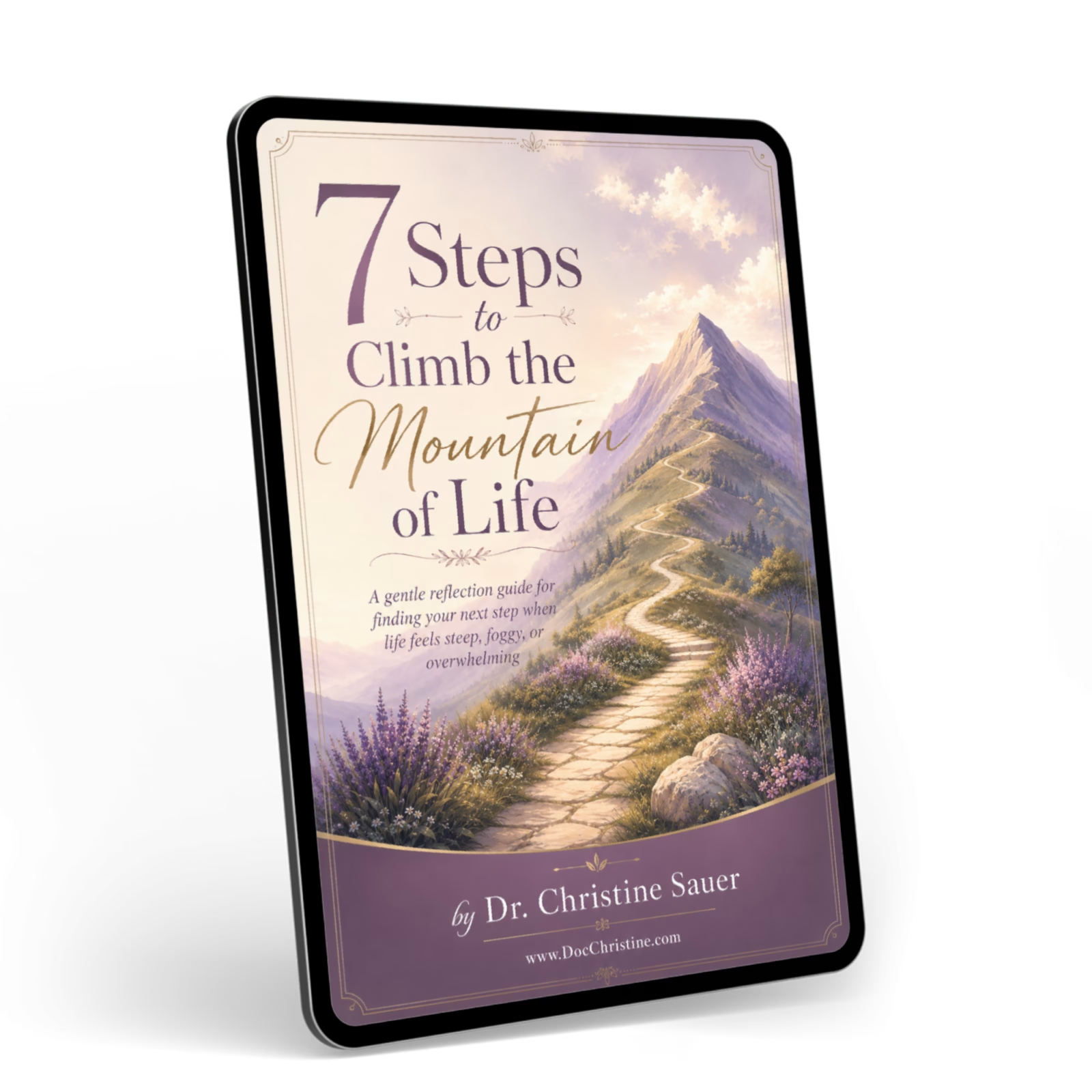
Very often, health system will only pay for medications and maybe certain small other aspects of what really would be necessary to heal a human, and very often, conventional physicians fail to help motivate their patients to even give them options and to endeavor on the path to climb the mountain of life - to do the deep work required and to fail - and try again…
It is not often considered how high the cost of failed approaches to mental suffering really is to society, as statistics blame the cost on the symptom (depression, anxiety, mental illness) and not the cause - as if there was no real help available.
And often, politicians and even public health authorities (and sadly, even some physicians) are motivated more by financial security and gains than by the true desire to make a positive difference.
(Did you know that large corporate Pharma and Agriculture is thriving and has a large budget for advertising and political influencing?)
There also is much political, media and individual pressure on individuals who express differing opinions or try to point out the facts.
They are told to “adhere to guidelines”, “follow the scientific consensus” or face the consequences - of losing their license, being demoted or ridiculed, exiled from established societies, having their peer-reviewed scientific paper not published or retracted - or being banned from media platforms. (And All these can be financially devastating).
Is there another way?
I believe there is, but it leads through a sea of fear, pain and tears. We have a choice.
Here are a few I came up with.
If you find others, please let me know.
- We can choose to develop or keep our ability to think critically and grow as human beings and as a society.
- We can try to isolate ourselves and live off the grid or in isolated communities
- We can think critically and support free speech of all, and, if needed, support other individuals who need our support in various ways as an uncertain future approaches.
- We can do this in opposition or while more or less complying with authorities - to be able to live in a society where we need some money,
- Or we can choose to “just go with the flow”, say “consumers”, “accept the status quo”, and just conform
- Or we can choose to violently and militantly persecute and harm those who live or think differently…
History is rich in examples of all these options, their reasons and their often devastating consequences.
Growing up in Germany, I am quite familiar about how Hitler came to power, a recent and quite impressive example of #6 (in a negative way)
I personally choose do not judge anyone who chooses any of the options (except of #6. I do not condone violence in any way to defend one’s opinions of beliefs)
Where do you stand when it comes to dealing with pain?
You can contact me here
P.S. You may like this story below. I found it online. It tells beautifully how most of us grew up (me included) - (slightly varied by me).
I invite you to think about this. No need to agree…:)
A Story of a Pleasing Child
As I was thinking about how we can heal the problem of many modern adults, I thought of this poetic allegory as a way to explore where many “nice” adults come from. Here is the allegory:
Once upon a time, in a land far away, a child was born. The child had everything in his heart: good and bad, a potential for nurturing love, and a potential for debilitating fear. More than anything, our child — a new traveler in this world — was hungry for being accepted and understood.
Unfortunately, the adults around him were all too stressed, too busy surviving, and too beat down to see his soul. They lived in a place that for a long time had been controlled by a mob, and they knew that in order to survive, one had to either "hustle strictly within the parameters," or just keep one’s head down.
Did they love their boy (let’s call the child a boy, feel free to substitute girl if you want)? Oh, they loved him! He was their precious boy! They wanted him to survive in this tough world and be happy, hopefully much happier than they were. But it is hard for beat-down adults to recognize a child’s sovereign soul if they have never taken the opportunity to recognize their own.
And so the parents of our boy taught him early on — with confidence of the people who internalized abuse — that in our world, a child gets approval and validation only when he follows the rules of the mob (in their mind, simply "rules").
They sprinkled their moral teachings with phrases like "tough life," "discipline," "order," "being a good child." With pride in their values, they instilled in him the rules of the mob and a habit to stick his neck out for the yoke.
They certainly thought they were being responsible parents, and they didn’t realize that they were acting as unwitting volunteer community managers for the mobsters. In fact, if somebody mentioned that possibility to them, they would be mighty insulted — and understandably so, given the good intention in their hearts and the difficulty of their lives. But none the less ...
Meanwhile, the child’s soul craved nourishing love and validation by the people around him, validation of his presence on this Earth. He wanted an ongoing confirmation of the fact that he was "real" and that he was "good." He was instinctively following all the things that got him soul-warming approval, like a plant that always turns its leaves toward the sunlight.
He didn’t know any fancy words but he knew that when he complied with the "rules," he was getting a pleasant reaction, and when he — intentionally or unintentionally — did something "bad," he experienced rejection by the people whose love he craved, and felt pain. He was just a child, after all!
Love or Letdown? Maybe Both?
Was our acceptance-seeking boy in a way let down by his adults? In a way, yes. They didn’t teach him that he was free, and they didn’t teach him the most important emotionally protective skill that adults can teach a child: sourcing love and acceptance from the inside.
Was that letdown malicious on their part though? God, no. They were themselves misled! And they loved him, they wanted him to succeed in the "real world" as they knew it, and they meant well.
There we have it. Compliant, “nice” adults are former good, acceptance-seeking kids who became adults in a nominal sense but who never learned to source love and confidence from the inside. Has anyone counted how many of them are in the world today? Billions, perhaps?
This story has many variations and many endings. Did our boy grow up in a bleak provincial town in a communist country, ruled by the Universal Bulldozer? In a resource-rich land invaded and destroyed by foreigners? In an affluent neighborhood somewhere in the "developed" world where the adults have chosen the path of being high-performing, half-sociopathic zombie drones?
And did our boy stay broken for many years to come — or was the pull of his soul so strong that he cried and screamed and protested the pain but nonetheless figured it out and found his soul?
Maybe you have an answer?
Want a clearer, less overwhelming way to think about brain and mental health?
Join the DRC email list for educational insights, frameworks, and evidence‑informed perspectives — no hype, no quick fixes.
Subscribers receive access to all essays in The Five Dimensions of Human Health series, including reflections that don’t appear on the public blog, as well as early drafts as the books take shape.
This is not a newsletter in the usual sense. It’s a place to think carefully, over time, about what health, suffering, and healing actually ask of us.
Join the Essays and receive them directly by email, as they’re written.
One thoughtful email most Tuesdays. Unsubscribe anytime.
Last Updated on May 21, 2026 by Dr. Christine Sauer